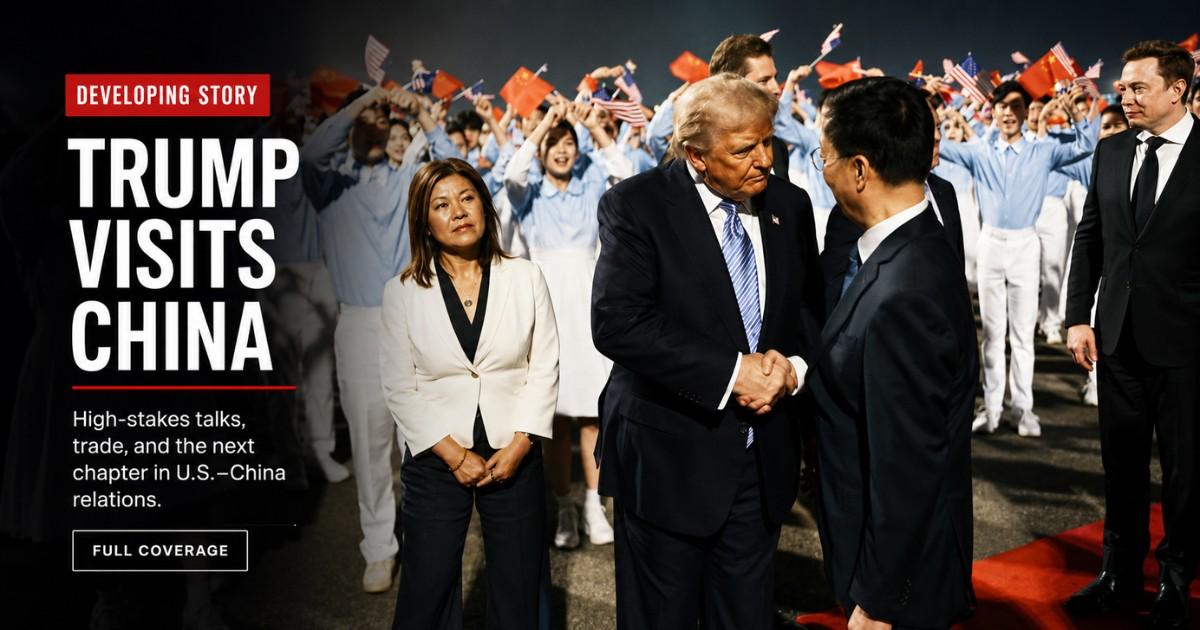
US President Donald Trump begins a high-profile Beijing visit aimed at easing trade tensions, boosting American exports and addressing key geopolitical flashpoints with Chinese President Xi Jinping
Donald Trump arrived in Beijing on Wednesday evening for a pivotal summit with Chinese President Xi Jinping, marking one of the most closely watched diplomatic engagements of the year amid growing global economic and geopolitical uncertainty.
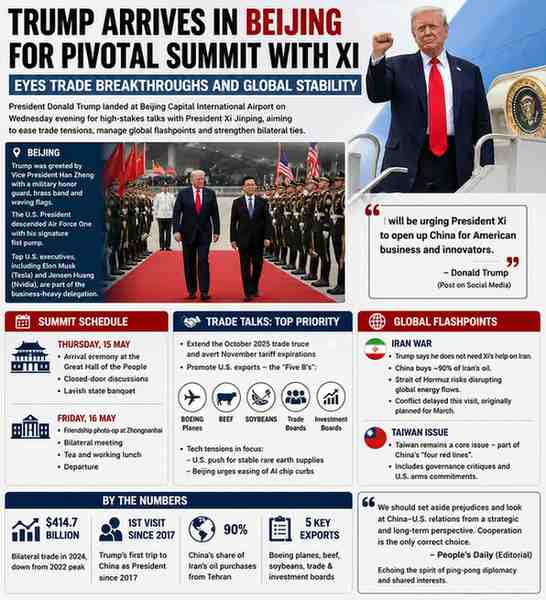
Trump landed at Beijing Capital International Airport nearly a decade after his previous official visit to China. The US President was welcomed with full state protocol by Chinese Vice President Han Zheng, alongside a military honour guard, ceremonial music performances and waving national flags.
As he stepped off Air Force One, Trump greeted officials and supporters with his signature fist pump while accompanied by several influential American business leaders, reflecting the strong economic focus of the visit.
The summit between Trump and Xi is expected to shape future relations between the United States and China on trade, technology, security and international economic cooperation.
Business Executives Join Trump Delegation
The American delegation travelling with Trump includes some of the most influential names in the global technology and business sectors.
Among them are Elon Musk and Jensen Huang, whose presence has drawn significant attention from global markets and industry observers.
The participation of major corporate leaders highlights Washington’s intention to strengthen trade ties and secure greater access for American businesses in Chinese markets.
Ahead of the summit, Trump stated on social media that he planned to encourage China to “open up” its economy further for American innovation and investment.
Analysts believe the inclusion of top technology executives also indicates the importance of semiconductor manufacturing, artificial intelligence and advanced technology cooperation in the discussions.
Formal Meetings to Begin at Great Hall of the People
Trump’s official engagements in Beijing are scheduled to begin on Thursday with a formal arrival ceremony at Great Hall of the People.
The programme includes bilateral talks between Trump and Xi, followed by a state banquet hosted by the Chinese leadership.
Diplomatic sources said the discussions will cover a broad range of strategic issues, including tariffs, trade relations, technology restrictions, regional security and global economic challenges.
On Friday, the meetings will continue at Zhongnanhai, the central headquarters of China’s political leadership.
The second day’s schedule includes additional bilateral discussions, a working lunch, a tea meeting and ceremonial interactions before Trump concludes his visit.
Trade Relations Expected to Dominate Summit Agenda
Trade negotiations are expected to remain the central focus of the summit as both countries attempt to avoid a renewed tariff confrontation.
The October 2025 trade truce between Washington and Beijing had temporarily eased tensions between the two economies, but several measures are set to expire later this year.
Trump is reportedly seeking an extension of the agreement while also pushing for broader access for American exports and investments.
Officials familiar with the agenda said the US administration is prioritising what it informally describes as the “Five B’s” strategy — involving Boeing aircraft, beef exports, soybeans and expanded trade and investment cooperation.
Economic experts noted that both governments are under pressure to prevent further disruption to global markets and supply chains.
Trade between the United States and China reportedly stood at approximately $414.7 billion last year, though overall volumes remain below earlier peak levels.
Observers believe the summit could play a key role in stabilising global economic confidence amid continuing uncertainty.
Technology Disputes Remain Major Challenge
Technology competition is expected to emerge as one of the most sensitive areas during the summit.
Washington is seeking stable access to Chinese rare earth materials, which are essential for electric vehicles, semiconductor production, defence manufacturing and renewable energy technologies.
At the same time, Beijing continues to oppose US restrictions on advanced semiconductor exports and artificial intelligence technologies to Chinese firms.
The presence of leading technology executives in Trump’s delegation further emphasises the strategic importance of these discussions.
Analysts said both countries are attempting to safeguard their technological advantages while preventing a complete breakdown in economic cooperation.
The outcome of the summit could significantly influence the future direction of the global semiconductor and AI industries.
Iran Conflict and Energy Concerns Also in Focus
Global security issues, particularly tensions involving Iran, are also expected to feature prominently in discussions between Trump and Xi.
Although Trump publicly stated that he does not require China’s assistance regarding Iran, experts believe Beijing’s economic relationship with Tehran gives it considerable geopolitical influence.
China remains one of the largest importers of Iranian oil, making it an important stakeholder in any disruption involving the Strait of Hormuz.
Diplomatic observers noted that the ongoing conflict in West Asia and concerns regarding global energy supplies may encourage both countries to explore areas of coordination.
Reports also suggested that the Middle East situation contributed to delays in Trump’s China visit earlier this year.
Taiwan Continues to Be a Sensitive Flashpoint
Taiwan remains one of the most contentious issues in US-China relations and is expected to be discussed cautiously during the summit.
China continues to view Taiwan as part of its sovereign territory and strongly opposes American military and political support for the island.
Chinese officials reportedly continue to describe Taiwan among Beijing’s “core red lines” in diplomatic relations with Washington.
Meanwhile, the United States has maintained its commitments regarding arms sales and defence cooperation with Taiwan.
Experts believe both leaders will seek to avoid direct confrontation on the issue while attempting to manage regional tensions in the Indo-Pacific.
Chinese Media Calls for Pragmatic Engagement
Ahead of the summit, Chinese state-linked media outlets adopted a relatively conciliatory tone regarding relations with the United States.
People’s Daily urged both countries to focus on practical cooperation rather than ideological divisions.
The publication referenced the era of “ping-pong diplomacy,” which played an important role in improving relations between the two countries during the Cold War period.
The messaging reflected Beijing’s attempt to project stability and openness ahead of the high-profile diplomatic engagement.
Political and Economic Stakes High for Both Leaders
Trump’s visit comes at a politically significant moment for both Washington and Beijing.
The US President is facing pressure to address inflation concerns, stabilise supply chains and demonstrate economic strength ahead of upcoming political contests in the United States.
For China, the summit represents an opportunity to improve relations with Washington while navigating economic challenges and global geopolitical competition.
Observers said any progress on trade or strategic communication could provide political and economic benefits to both governments.
Global Attention Fixed on Trump-Xi Summit
The Beijing summit is being closely monitored around the world because of its potential impact on trade, technology, financial markets and international security.
Relations between the United States and China have remained strained in recent years over tariffs, technology restrictions, military competition and regional influence.
Despite those tensions, the two economies remain deeply interconnected, making diplomatic engagement critical for global stability.
Analysts believe the summit will test whether personal diplomacy between Trump and Xi can reduce tensions and create limited areas of cooperation between the world’s two most powerful nations.
While expectations of a major breakthrough remain cautious, even modest progress during the visit could significantly influence the global economic and geopolitical landscape in the months ahead.
Key Insights
- The summit comes at a sensitive phase in United States–China relations, where economic interdependence continues despite deepening strategic rivalry over technology, supply chains, military influence, and regional security.
- Trade discussions are likely to focus not only on tariff relief but also on broader supply-chain stability, particularly in sectors such as semiconductors, rare earth minerals, aerospace, agriculture, and electric vehicles, which remain central to both economies.
- China’s dominance in rare earth processing and critical mineral supply chains gives Beijing substantial leverage in global technology manufacturing, making export controls and access negotiations increasingly important for American industries.
- The inclusion of major technology and business leaders in the U.S. delegation signals that commercial diplomacy is expected to play a major role alongside traditional geopolitical negotiations, especially as both countries seek to protect domestic economic growth amid slowing global demand.
- Taiwan remains one of the most sensitive issues in bilateral ties, and any shift in rhetoric or military posture from either side could have wider implications for Indo-Pacific stability, global semiconductor supply chains, and regional alliances.
- The reference to extending the 2025 trade truce suggests concerns within both governments about renewed tariff escalation, which could affect global markets, manufacturing costs, inflation trends, and investor sentiment internationally.
- Discussions linked to Iran and energy security reflect the increasingly interconnected nature of global geopolitics, where conflicts in West Asia can directly influence U.S.-China diplomacy through oil markets, shipping routes, and sanctions enforcement.
- The summit also carries domestic political significance for Donald Trump, as easing trade tensions and stabilising prices could become key economic talking points ahead of U.S. electoral cycles.
- Analysts are expected to closely watch whether the visit produces concrete agreements or primarily serves as a confidence-building exercise aimed at preventing further deterioration in relations between the world’s two largest economies.
- The renewed emphasis on “pragmatic cooperation” reflects growing recognition on both sides that prolonged instability in U.S.-China relations could have broad consequences for global trade, financial markets, climate coordination, and emerging technology governance.
Inputs & Images: Hindusthan Samachar
Edited By: Akshaya Polepalli
Also Read: N. Rangasamy Takes Oath as Puducherry Chief Minister for Record Fifth Term
Follow us on google news: Click Here