The CBSE Evaluation System Review has become one of the most discussed education topics across India, drawing attention from students, parents, teachers and policy experts. Recent discussions around assessment methods, answer sheet evaluation and examination reforms have placed the CBSE Evaluation System Review firmly in the spotlight. As board examinations continue to influence academic pathways and career opportunities, any move connected to evaluation standards naturally generates nationwide interest.
CBSE Evaluation System Review Gains National Attention
The growing focus on the CBSE Evaluation System Review comes at a time when education stakeholders are demanding greater transparency, consistency and fairness in the marking process. Students want assurance that their performance is being judged accurately, while parents seek confidence that examination outcomes truly reflect learning and effort. Educators, meanwhile, are looking for systems that balance academic rigor with modern assessment practices.
One of the main reasons the CBSE Evaluation System Review is attracting attention is the increasing conversation around how answer sheets are assessed. Board examinations involve millions of students every year, making evaluation a massive exercise. Even small improvements in checking procedures, moderation policies and examiner training can have a significant impact on final results. As a result, discussions about evaluation reforms often become major public interest stories.
Why the CBSE Evaluation System Review Matters
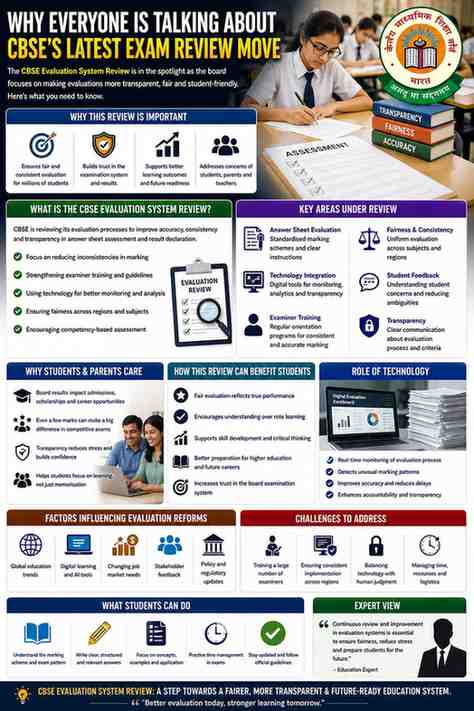
Supporters of the CBSE Evaluation System Review argue that continuous assessment improvements are necessary in an evolving education environment. Learning methods have changed dramatically over the past decade. Students now have access to digital resources, online learning platforms and artificial intelligence tools. Evaluation systems must adapt to measure not only memorization but also analytical thinking, problem solving and conceptual understanding.
Another important aspect of the CBSE Evaluation System Review is the emphasis on reducing inconsistencies in marking. Different examiners may sometimes interpret answers differently, particularly in descriptive subjects. Standardized guidelines, detailed marking schemes and improved monitoring mechanisms can help create greater uniformity. This is especially important because even a few marks can influence admissions to prestigious colleges and universities.
The discussion surrounding the CBSE Evaluation System Review also reflects broader changes taking place in Indian education. Policymakers have increasingly emphasized competency based learning, encouraging students to understand concepts rather than rely solely on rote learning. Evaluation methods that reward application of knowledge are seen as more relevant for preparing students for higher education and future careers.
CBSE Evaluation System Review and Student Performance
Parents are closely following the CBSE Evaluation System Review because examination results remain highly influential in academic planning. Strong board scores can open doors to scholarships, competitive courses and leading institutions. Any update connected to evaluation standards therefore becomes a matter of public interest. Families want clarity about how answers are assessed and whether reforms could affect scoring patterns.
Teachers also play a vital role in conversations about the CBSE Evaluation System Review. Classroom instruction is often shaped by examination requirements. When evaluation criteria evolve, teaching strategies may also change. Educators need clear guidance on expected learning outcomes so they can help students prepare effectively. Improved communication between boards and schools can make transitions smoother for everyone involved.
Technology is another major factor shaping the CBSE Evaluation System Review. Digital evaluation systems, online monitoring tools and data driven quality checks have the potential to improve accuracy and efficiency. Technology can help identify unusual marking patterns, reduce administrative delays and strengthen accountability. While human judgment remains central to evaluation, technological support can enhance overall reliability.
How the CBSE Evaluation System Review Could Improve Transparency
The CBSE Evaluation System Review has also sparked discussions about student stress. Board examinations are often associated with intense academic pressure. Many experts believe that transparent evaluation procedures can help reduce anxiety by increasing trust in the assessment process. When students understand how marks are awarded and what examiners expect, they may feel more confident during examinations.
A key theme emerging from the CBSE Evaluation System Review is fairness. Fair evaluation is essential for maintaining confidence in any examination system. Students invest months, and sometimes years, preparing for board exams. They expect their efforts to be assessed objectively. Reforms aimed at strengthening consistency and reducing ambiguity are therefore likely to receive significant public support.
The national attention surrounding the CBSE Evaluation System Review demonstrates how deeply education matters to Indian society. Examination systems influence not only individual futures but also broader perceptions of academic excellence. As competition for higher education opportunities continues to grow, stakeholders are paying closer attention to every aspect of the assessment process.
Future Impact of the CBSE Evaluation System Review
Experts suggest that the CBSE Evaluation System Review could encourage greater focus on skill development. Traditional examinations have often been criticized for rewarding memorization. Modern evaluation approaches increasingly emphasize creativity, critical thinking and practical application. If implemented effectively, such changes could help align school education with the demands of a rapidly changing economy.
Students preparing for future board examinations are particularly interested in the CBSE Evaluation System Review because it may shape expectations regarding answer writing and exam preparation. Understanding marking criteria can help learners focus on presenting responses clearly, supporting arguments effectively and demonstrating conceptual understanding. Greater awareness of evaluation standards may ultimately contribute to better academic performance.
The conversation about the CBSE Evaluation System Review is also important because it highlights the need for continuous improvement rather than one time reform. Education systems must evolve alongside changing learning patterns and societal expectations. Regular reviews allow authorities to identify challenges, gather feedback and introduce practical solutions that strengthen confidence in examinations.
As discussions continue, the CBSE Evaluation System Review is likely to remain a major topic among students, parents and educators. Whether the focus is transparency, fairness, technology integration or competency based assessment, the broader objective remains the same: creating an evaluation framework that accurately reflects student learning. In an increasingly competitive academic environment, trust in examination processes is essential. The ongoing attention surrounding the CBSE Evaluation System Review underscores the importance of credible assessment systems and the continuing effort to ensure that every student’s performance is evaluated with consistency, accuracy and fairness.
Beyond examination halls, the CBSE Evaluation System Review has become a frequent topic on social media platforms, educational forums and student communities. Many learners are sharing experiences, discussing marking trends and seeking clarity about evaluation procedures. This heightened engagement reflects a growing awareness of how assessment systems function and why transparency matters. Public discussions can also encourage constructive feedback that helps authorities identify areas requiring further attention.
Another dimension of the CBSE Evaluation System Review involves examiner training. Experienced evaluators often emphasize that clear instructions and regular orientation programs contribute significantly to accurate marking. When examiners follow uniform standards, students are more likely to receive scores that fairly represent the quality of their responses. Strengthening training mechanisms can therefore support the broader goal of consistency across subjects and regions.
Looking ahead, the CBSE Evaluation System Review may influence future reforms in school assessment practices. Educational experts increasingly advocate a balanced approach that combines academic knowledge with practical skills, communication abilities and problem solving competence. Such perspectives are shaping conversations about how examinations should evolve in the coming years. While changes require careful implementation, the ongoing review process demonstrates a commitment to maintaining credibility and adapting to the needs of modern learners across India today.
For many observers, the CBSE Evaluation System Review represents an opportunity to strengthen confidence, encourage academic excellence, support fairness and improve educational outcomes nationwide for future generations.
Key Insights
- The CBSE Evaluation System Review has emerged as one of India’s most discussed education topics, attracting attention from students, parents, teachers, and policy experts.
- Growing discussions around answer sheet assessment, marking standards, transparency, and examination reforms are driving nationwide interest in the review process.
- Board examinations remain highly influential in determining academic opportunities, making any evaluation-related changes a matter of significant public interest.
- Stakeholders are increasingly demanding greater transparency, consistency, fairness, and accountability in the examination assessment process.
- Students want assurance that their performance is being evaluated accurately and objectively.
- Parents seek confidence that examination scores genuinely reflect student learning, effort, and academic ability.
- Educators are advocating for evaluation systems that maintain academic rigor while adapting to modern learning practices.
- One of the primary focuses of the CBSE Evaluation System Review is improving answer sheet assessment procedures across millions of board exam papers.
- Even small improvements in examiner guidelines, moderation policies, and evaluation procedures can significantly impact final student results.
- Supporters argue that regular evaluation reviews are necessary because educational methods and learning environments are evolving rapidly.
- The rise of digital learning platforms, online resources, and artificial intelligence tools is changing how students learn and prepare for examinations.
- Experts believe modern assessment systems should measure analytical thinking, conceptual understanding, problem-solving abilities, and application of knowledge rather than rote memorization alone.
- Reducing inconsistencies in marking remains a key objective of the review process.
- Different examiners may interpret descriptive answers differently, making standardized marking schemes increasingly important.
- Improved examiner guidelines and monitoring systems can help create more uniform scoring across regions and subjects.
- Fair and consistent evaluation is especially critical because a small difference in marks can affect admissions to competitive colleges, universities, and scholarship programs.
- The review reflects broader changes in India’s education system, including a growing emphasis on competency-based learning.
- Policymakers are increasingly promoting assessments that reward understanding and practical application rather than memorization.
- Parents are closely monitoring evaluation reforms because board examination scores continue to play a major role in academic planning and career opportunities.
- Teachers are expected to adapt classroom instruction and preparation strategies as evaluation criteria evolve.
- Clear communication between examination boards and schools is essential for smooth implementation of any assessment reforms.
- Technology is becoming a significant component of modern evaluation systems.
- Digital evaluation tools, online monitoring systems, and data-driven quality checks can improve efficiency, consistency, and reliability.
- Technology can help identify unusual marking patterns, reduce administrative delays, and strengthen accountability throughout the evaluation process.
- Experts emphasize that technological support should enhance, rather than replace, human judgment in academic assessment.
- Increased transparency in evaluation procedures may help reduce examination-related stress and anxiety among students.
- Understanding marking criteria and examiner expectations can improve student confidence during board examinations.
- Fairness remains one of the most important themes emerging from discussions around the CBSE Evaluation System Review.
- Students and families expect months or years of preparation to be assessed objectively and consistently.
- The national attention surrounding the review highlights the importance of trust and credibility in examination systems.
- Experts believe future reforms could place greater emphasis on creativity, critical thinking, communication skills, and practical problem-solving.
- Students preparing for future board examinations are particularly interested in understanding evolving marking criteria and answer-writing expectations.
- Greater awareness of evaluation standards may help students present responses more effectively and improve academic performance.
- The review process is being viewed as an ongoing effort toward continuous improvement rather than a one-time reform initiative.
- Regular evaluation reviews allow authorities to gather stakeholder feedback, identify challenges, and strengthen confidence in examination systems.
- Social media platforms, student communities, and educational forums have amplified discussions around marking trends and evaluation practices.
- Increased public engagement reflects growing awareness about how examination systems function and why transparency matters.
- Examiner training has emerged as another important aspect of the review process.
- Education experts believe regular orientation programs and clear evaluation instructions help ensure more accurate and consistent marking.
- Strong examiner training frameworks can support uniform standards across subjects, schools, and regions.
- The review may influence broader future reforms in school assessment systems across India.
- Educational experts increasingly advocate a balanced assessment model that combines academic knowledge, practical skills, communication abilities, and critical thinking.
- Many observers view the CBSE Evaluation System Review as an opportunity to strengthen public trust, support fairness, encourage academic excellence, and improve educational outcomes nationwide.