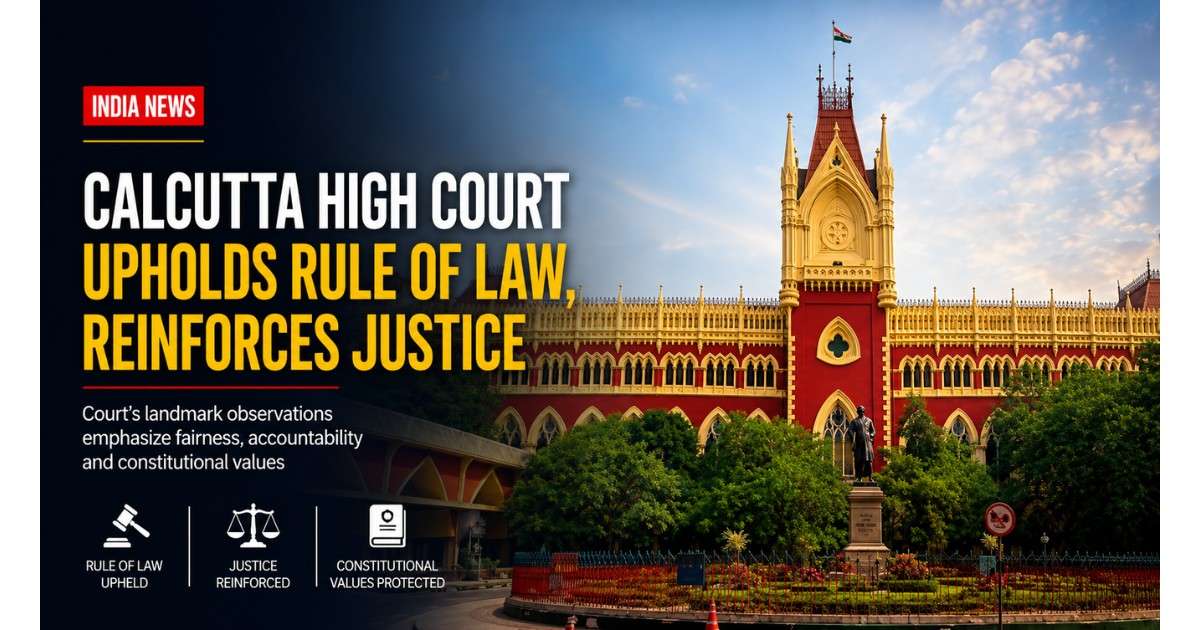
Calcutta High Court stayed the demolition of an allegedly illegal building in Kolkata’s Tiljala area after a deadly fire incident, while refusing rehabilitation for residents.
Calcutta High Court on Friday imposed an interim stay on the demolition of an allegedly illegal multi-storey structure in the Tiljala area of Kolkata following a recent fire tragedy that claimed two lives.
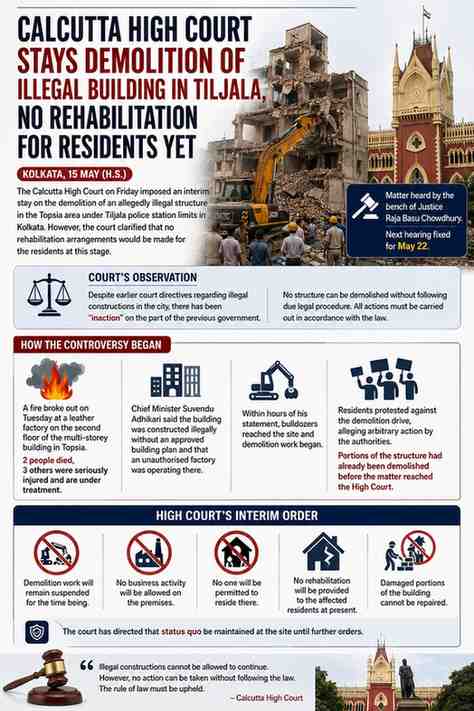
The matter was heard by the bench of Justice Raja Basu Chowdhury, which directed authorities to suspend demolition activities for the time being and scheduled the next hearing in the case for May 22.
At the same time, the court clarified that no rehabilitation arrangements would be provided to residents currently affected by the dispute. It also directed that no one would be permitted to reside in or conduct business activities from the premises until further orders.
The case has drawn significant public and political attention after portions of the building were demolished shortly after state authorities declared the structure illegal in the aftermath of the fire incident.
Fire Incident Triggered Major Controversy
The controversy surrounding the building began after a massive fire broke out on Tuesday inside a leather factory operating on the second floor of the structure located in the Topsia-Tiljala area.
According to officials, two people lost their lives in the blaze while three others sustained serious injuries and continue to undergo treatment at a hospital.
Emergency teams and firefighters rushed to the scene to control the fire and evacuate residents and workers trapped inside the building.
Authorities later stated that the factory had allegedly been operating without proper authorisation inside a structure that itself lacked an approved building plan.
The incident triggered fresh concerns over illegal constructions and unauthorised commercial activities operating in densely populated parts of Kolkata.
Suvendu Adhikari Ordered Action After Incident
Following the fire tragedy, Suvendu Adhikari stated that the building had been constructed illegally and that an unauthorised leather factory was functioning within the premises.
Soon after the Chief Minister’s remarks, demolition teams and bulldozers reportedly arrived at the site and initiated demolition work on portions of the building.
The rapid action sparked protests from local residents, many of whom alleged that the authorities acted arbitrarily without providing proper notice or following legal procedures.
Several families residing in the building claimed they were suddenly displaced after demolition activities began.
The issue subsequently reached the Calcutta High Court, where petitioners challenged the legality of the demolition process.
High Court Questions Previous Administrative Inaction
During the hearing, the High Court reportedly observed that despite earlier judicial directions concerning illegal constructions across Kolkata, there had been significant administrative inaction under the previous government.
The court noted that unauthorised structures and illegal commercial establishments continue to pose serious risks to public safety in urban areas.
However, the bench also stressed that even allegedly illegal constructions cannot be demolished without following due legal procedure.
Justice Raja Basu Chowdhury observed that all administrative actions must strictly comply with the law and constitutional safeguards.
Legal experts noted that the order reinforces the principle that procedural fairness must be maintained even in cases involving illegal constructions.
Court Orders Status Quo at Site
In its interim order, the High Court directed that status quo be maintained at the site until further hearings in the matter.
The court specifically instructed authorities to halt further demolition activities for the time being.
At the same time, it imposed restrictions on the use of the premises.
According to the order, no commercial or business operations will be permitted inside the building, and residents will also not be allowed to occupy the structure until further decisions are taken.
The court additionally clarified that no repair work can be undertaken on already damaged portions of the building.
Officials said the order is aimed at preventing any further alteration of the disputed property while legal proceedings continue.
No Rehabilitation for Residents at Present
One of the most significant aspects of the court’s order was its refusal to grant immediate rehabilitation relief to residents affected by the demolition drive.
The High Court stated that no rehabilitation arrangements would be made at this stage of the proceedings.
This decision has created uncertainty for several families who were residing in the building before demolition work commenced.
Some residents argued that while the legality of the building may be under question, innocent occupants should not be left without shelter.
Legal observers noted that rehabilitation issues may be addressed separately depending on future court proceedings and findings regarding responsibility for the construction.
Illegal Constructions Under Renewed Scrutiny
The Tiljala incident has once again placed the spotlight on the issue of illegal buildings and unauthorised commercial operations in Kolkata and other urban centres.
Urban planners and civic experts have repeatedly warned that unauthorised constructions often bypass safety regulations, increasing the risk of accidents, fires and structural failures.
Several deadly incidents involving illegal buildings have occurred in different parts of India in recent years, prompting courts and governments to strengthen monitoring mechanisms.
Officials believe the latest tragedy may trigger wider inspections of unauthorised industrial and commercial units functioning inside residential buildings across Kolkata.
The case has also intensified political debate regarding accountability and enforcement failures.
Residents Protest Demolition Action
Residents affected by the demolition drive protested against the authorities, alleging that the action was carried out without adequate notice and proper rehabilitation planning.
Some families claimed they lost belongings and faced sudden displacement after bulldozers arrived at the site.
Visuals from the area showed sections of the building partially demolished before the High Court intervened.
Local residents also demanded clarity regarding their future housing situation and sought assurances regarding safety and legal protection.
Human rights activists and civic groups have argued that while illegal structures must be addressed, authorities should also consider humanitarian concerns affecting residents.
Next Hearing Scheduled for May 22
The Calcutta High Court has fixed May 22 as the next date of hearing in the case.
During the upcoming proceedings, the court is expected to examine the legality of the building, the demolition process initiated by authorities and the responsibilities of various civic and administrative agencies.
Legal experts believe the case could have broader implications for future action against illegal constructions in Kolkata and other parts of West Bengal.
The matter is also likely to shape discussions around balancing urban law enforcement with procedural safeguards and residents’ rights.
Until further orders are issued, the court has directed all parties to maintain status quo at the site, ensuring that no further demolition, repair or occupancy takes place inside the disputed structure.
Key Insights
The proceedings could have wider implications for future civic enforcement actions in West Bengal, especially concerning how authorities handle unsafe or unauthorised buildings after accidents or public safety incidents.
The interim stay by the Calcutta High Court underscores the judiciary’s emphasis on due process in cases involving alleged illegal constructions, even when public safety concerns and political pressure are significant.
The court’s observation regarding administrative “inaction” highlights a recurring urban governance challenge in major Indian cities, where unauthorised constructions often expand over time because of weak enforcement, delayed inspections, and regulatory lapses.
The case draws attention to the broader issue of mixed residential and industrial use in densely populated urban pockets of Kolkata, where unapproved commercial activities inside residential structures can substantially increase fire and safety risks.
By prohibiting both habitation and business activity while also denying immediate rehabilitation, the court appears to be balancing safety concerns with legal scrutiny over whether demolition procedures were initiated in compliance with statutory norms.
The incident may intensify scrutiny of municipal approval systems, fire safety compliance, and enforcement mechanisms relating to small-scale industrial operations functioning within residential neighbourhoods.
The fire tragedy, which resulted in fatalities and injuries, is likely to renew debate around urban disaster preparedness and the adequacy of safety inspections in congested industrial-residential zones across metropolitan cities.
The case also reflects the growing judicial oversight of demolition drives in India, where courts increasingly examine whether executive action follows constitutional safeguards, notice procedures, and principles of natural justice.
The absence of immediate rehabilitation support may raise humanitarian and policy concerns regarding displaced residents, particularly in cases where occupants may not have been directly involved in alleged regulatory violations.
Inputs & Images: Hindusthan Samachar
Edited By: Akshaya Polepalli
Also Read: Kerala Braces for Heavy Rain as IMD Issues Yellow Alert Across Multiple Districts
Follow us on google news: Click Here