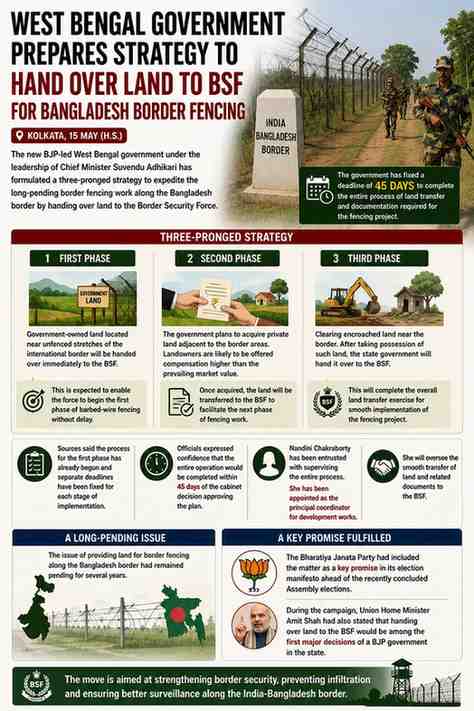
The West Bengal government has prepared a three-phase strategy to transfer land to the BSF and accelerate Bangladesh border fencing within 45 days.
The newly formed BJP-led government in West Bengal under the leadership of Suvendu Adhikari has initiated an ambitious strategy to expedite the long-delayed border fencing work along the India-Bangladesh international border.
According to sources within the state administration, the government has designed a three-phase plan to hand over land to the Border Security Force (BSF) for the construction of fencing in vulnerable and previously unfenced stretches.
Officials said the government has fixed a strict deadline of 45 days to complete the process of land identification, acquisition, clearance and documentation related to the fencing project.
The development marks one of the first major administrative initiatives undertaken by the new BJP government after assuming office in the state.
Border Fencing Among BJP’s Key Election Promises
The issue of incomplete fencing along the Bangladesh border had remained a politically sensitive matter in West Bengal for several years.
The Bharatiya Janata Party repeatedly accused previous state administrations of delaying the transfer of land required for fencing projects, arguing that the lack of barriers created security vulnerabilities along the international border.
During the recently concluded Assembly election campaign, the BJP highlighted border security as one of its major governance priorities.
Amit Shah had also stated during campaign rallies that handing over land to the BSF for fencing would be among the first significant decisions taken if the BJP formed the government in West Bengal.
Following the party’s electoral victory, the state administration has now moved quickly to operationalise the promise.
Three-Phase Strategy Finalised by Government
According to officials familiar with the plan, the state government has prepared a structured three-phase strategy to complete the land transfer process efficiently and within a fixed timeline.
Authorities believe the phased approach will help avoid administrative delays and allow fencing work to progress rapidly in sensitive border areas.
The strategy involves immediate transfer of government land, acquisition of private land and removal of encroachments near the international border.
Officials said separate deadlines have been fixed for each stage to ensure timely implementation.
First Phase Focuses on Government-Owned Land
Under the first phase of the plan, government-owned land located near unfenced border stretches will be transferred directly to the BSF.
Officials stated that this step would allow fencing work to begin immediately in several sectors without waiting for lengthy acquisition procedures.
The administration has reportedly already started identifying plots of government land suitable for fencing activities.
Authorities believe this phase can be completed relatively quickly because the land already falls under state ownership.
The immediate transfer of such land is expected to enable the BSF to initiate the first phase of barbed-wire fencing work in priority zones along the international border.
Private Land Acquisition Planned in Second Phase
The second phase of the strategy will involve acquisition of privately owned land located adjacent to border areas where fencing remains incomplete.
Officials said the government is planning to offer compensation above prevailing market rates in an attempt to minimise disputes and speed up land acquisition.
The administration hopes the compensation model will encourage cooperation from landowners and reduce the likelihood of prolonged legal challenges.
After acquisition procedures are completed, the land will be formally handed over to the BSF for fencing construction.
Officials acknowledged that private land acquisition could be one of the more challenging components of the project because many border areas are densely populated and agriculturally active.
However, authorities expressed confidence that the process would move smoothly under the new framework.
Encroached Land to Be Cleared in Final Phase
The third and final phase of the strategy will focus on clearing encroachments on land located near the border.
According to officials, encroached plots that obstruct fencing work will be identified, cleared and subsequently transferred to the BSF.
Authorities stated that surveys are being conducted to determine the extent of encroachments along sensitive stretches of the border.
Once possession is regained, the administration intends to complete all pending documentation and facilitate rapid fencing construction.
Officials said this phase would require close coordination between district administrations, law enforcement agencies and border security authorities.
45-Day Deadline Fixed for Entire Operation
One of the most significant aspects of the new strategy is the government’s decision to impose a strict 45-day deadline for completing the entire process.
Officials stated that the cabinet has already approved the broad framework of the initiative and instructed departments to work in mission mode.
Separate timelines have reportedly been assigned for land identification, acquisition procedures, encroachment removal and document transfer.
Senior officials believe the fixed deadline will ensure accountability and reduce bureaucratic delays that had stalled the project in previous years.
The administration has indicated that regular progress reviews will be conducted to monitor implementation.
Nandini Chakraborty Appointed Principal Coordinator
The state government has entrusted senior bureaucrat Nandini Chakraborty with supervising and coordinating the entire land transfer process.
Officials said she has been appointed as the principal coordinator for development-related works linked to the border fencing initiative.
Her responsibilities will include overseeing coordination between departments, resolving administrative bottlenecks and ensuring smooth transfer of land-related documentation to the BSF.
The appointment reflects the government’s intention to centralise supervision of the project and accelerate implementation through direct monitoring at the highest administrative level.
Strategic Importance of Bangladesh Border Fencing
West Bengal shares one of the longest stretches of the India-Bangladesh border, covering several districts including North 24 Parganas, Nadia, Murshidabad, Malda and Cooch Behar.
Security agencies have repeatedly highlighted concerns regarding infiltration, cross-border smuggling and illegal movement across unfenced sections of the border.
Border fencing has therefore long been considered a crucial national security measure aimed at improving surveillance and strengthening border management.
Officials believe completion of fencing will help improve operational efficiency for the BSF while reducing illegal cross-border activities.
The project is also expected to strengthen monitoring of sensitive areas prone to smuggling of cattle, narcotics and counterfeit goods.
Political Significance of the Move
Political analysts view the border fencing initiative as an important symbolic and administrative move by the newly formed BJP government in West Bengal.
The BJP had consistently criticised previous administrations for allegedly delaying land transfers needed for border infrastructure projects.
By prioritising the fencing issue soon after taking office, the new government appears keen to demonstrate quick action on key campaign promises.
Observers believe the move is also intended to reinforce the BJP’s political narrative around national security and border management in eastern India.
The issue carries substantial political weight in border districts where concerns regarding illegal migration and security have frequently shaped electoral debates.
BSF Expected to Accelerate Fencing Work
With the state government now initiating land transfers, the BSF is expected to speed up construction of fencing infrastructure along remaining unfenced stretches.
Officials indicated that coordination mechanisms between state authorities and the BSF are already being strengthened to facilitate rapid implementation.
The fencing project is expected to include barbed-wire barriers, patrol roads, floodlighting and surveillance infrastructure in sensitive sectors.
Authorities believe the initiative will not only improve security but also support better administrative control in border regions.
Government Seeks Faster Completion of Long-Pending Project
The issue of incomplete fencing along the Bangladesh border had remained unresolved for years due to land-related complications and administrative hurdles.
Officials said the new strategy is designed specifically to overcome those obstacles through a phased, deadline-driven approach.
The government has expressed confidence that the entire process of land transfer and documentation can be completed within the stipulated timeframe.
If implemented successfully, the initiative could mark a major step forward in strengthening border infrastructure and fulfilling one of the BJP government’s major electoral commitments in West Bengal.
Key Insights
- The proposed acceleration of border fencing along the Bangladesh frontier reflects the strategic importance of border management in West Bengal, which shares one of the longest and most densely populated international borders in the country.
- The three-phase approach involving government land transfer, private land acquisition, and encroachment clearance suggests an attempt to address one of the key administrative bottlenecks that has historically delayed fencing projects in several border districts.
- Faster completion of fencing infrastructure could strengthen surveillance and movement control in sensitive stretches often associated with concerns related to smuggling, illegal cross-border movement, cattle trafficking, and organised criminal networks.
- The emphasis on compensation above prevailing market rates indicates that the government may be seeking to reduce resistance from landowners and minimise litigation risks that frequently slow large-scale land acquisition exercises.
- The move also highlights the increasing coordination between state administrations and central security agencies such as the Border Security Force in implementing national border infrastructure projects.
- Clearing encroached land near border areas may become legally and politically sensitive, particularly if rehabilitation, ownership disputes, or livelihood concerns emerge during implementation.
- The 45-day target reflects an effort to project administrative urgency and governance efficiency, although large-scale land documentation and transfer processes often face procedural, legal, and logistical complexities on the ground.
- The initiative carries broader geopolitical significance because border fencing forms part of India’s wider security and migration management framework along the eastern frontier, especially in areas with heavy population movement and informal trade networks.
- The project may also have socio-economic implications for border communities, where fencing can alter local mobility patterns, agricultural access, and traditional cross-border interactions that have historically shaped life in frontier districts.
- Politically, the move aligns with a major election commitment of the Bharatiya Janata Party and reflects how border security continues to remain a prominent governance and electoral issue in eastern India.
Inputs & Images: Hindusthan Samachar
Edited By: Akshaya Polepalli
Also Read: SSG Road Reopened for Two-Way Traffic After Snow Clearance, Authorities Issue Strict Travel Advisory
Follow us on google news: Click Here