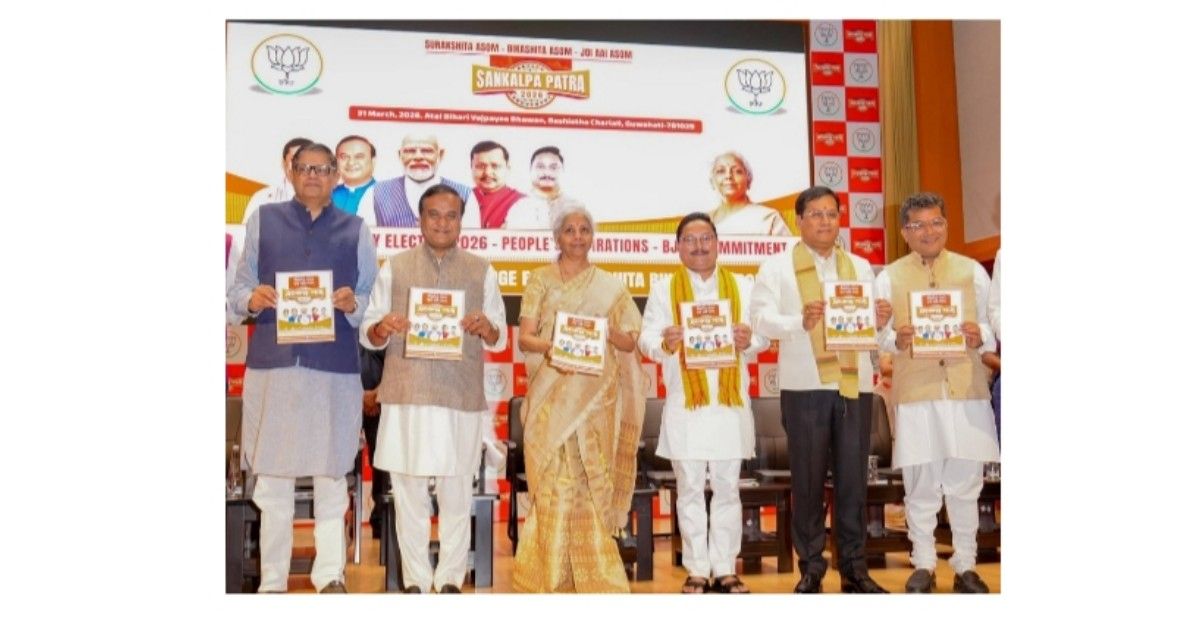
Guwahati, March 31: Nirmala Sitharaman attended the Bharatiya Janata Party’s (BJP) manifesto release event for the upcoming Assam Assembly elections in Guwahati on Tuesday, drawing attention for her choice of traditional Assamese attire.
The Union Finance Minister was seen wearing a golden Muga silk Mekhela Chador, a traditional outfit widely associated with Assam’s cultural identity. Her appearance at the event combined political messaging with a visible nod to regional heritage.
Cultural Symbolism at a Political Event
The presence of traditional attire at a major political gathering added a cultural dimension to the manifesto launch.
Nirmala Sitharaman’s outfit reflected the aesthetic and historical significance of Assamese textiles, particularly Muga silk, which is unique to the region and known for its natural golden sheen and durability.
Attendees at the event responded positively, viewing the gesture as recognition of local traditions and cultural pride. Such symbolic expressions often resonate strongly in states where cultural identity plays an important role in public life.
BJP Manifesto and Development Focus
Following the unveiling of the party’s manifesto, Sitharaman spoke about the BJP’s vision for Assam, stating that it builds on developments achieved over the past decade.
She highlighted the party’s focus on infrastructure, welfare initiatives, and economic growth, presenting the document as a roadmap for the state’s future.
The manifesto release marks a key step in the BJP’s campaign strategy as it prepares for the Assembly elections.
Presence of Senior Leadership
The event saw participation from several prominent leaders, including Sarbananda Sonowal, Himanta Biswa Sarma, and Dilip Saikia.
Their presence underscored the importance of the occasion and reflected coordinated efforts by party leadership at both the central and state levels.
Such gatherings serve as platforms to consolidate campaign messaging and present a unified political front.
Traditional Attire: Mekhela Chador Explained
The Mekhela Chador is the traditional dress worn by women in Assam and holds significant cultural value.
It consists of two main components:
- Mekhela: A skirt-like lower garment
- Chador: A draped upper cloth
The attire is commonly made from fabrics such as Muga silk, Pat silk, or cotton. Among these, Muga silk is particularly prized for its texture, natural colour, and durability.
The Mekhela Chador is widely worn during festivals, weddings, and formal occasions, making it an enduring symbol of Assamese identity.
Cultural Outreach in Political Messaging
The use of traditional attire by political leaders is often seen as a way to connect with local communities and acknowledge regional cultures.
In Assam, such gestures carry additional significance due to the state’s rich cultural heritage and strong sense of identity.
Narendra Modi has previously been seen wearing the traditional Assamese Gamocha during public appearances, both within India and on international platforms, highlighting similar efforts to showcase regional traditions.
Sitharaman’s choice of attire is being viewed in a similar context, as part of a broader effort to engage with local culture during the election campaign.
Political Context Ahead of Elections
The manifesto launch comes at a time when political parties are intensifying their campaigns across Assam.
Key issues in the election are expected to include development, infrastructure, employment, and social welfare, alongside broader concerns such as identity and governance.
Events like manifesto releases provide parties with an opportunity to outline their priorities and communicate their vision to voters.
Public Response and Significance
The visual symbolism of the event, particularly the emphasis on traditional attire, has generated interest among attendees and observers.
For many, such gestures reinforce the importance of preserving and promoting regional culture, even in political settings.
At the same time, voters are likely to focus on the substantive aspects of the manifesto, evaluating policy proposals and their potential impact on daily life.
Intersection of Culture and Politics
The blending of cultural elements with political messaging reflects a broader trend in Indian politics, where identity and tradition often play a role in shaping public engagement.
By incorporating regional symbols into campaign events, political leaders aim to create a sense of connection with local communities.
However, the effectiveness of such efforts ultimately depends on how they are complemented by policy initiatives and governance outcomes.
Outlook Ahead
The participation of Nirmala Sitharaman in the Assam manifesto launch, coupled with her choice of traditional attire, highlights both cultural and political dimensions of the ongoing election campaign.
As the electoral process unfolds, attention will shift to how parties translate their promises into actionable plans and how voters respond to competing narratives.
The event underscores the evolving nature of political communication, where cultural representation and policy messaging increasingly go hand in hand.
Inputs & Images: Hindusthan Samachar
Edited By: Akshaya Polepalli
Also Read: Abhijit S. Pendharkar Appointed DGMO, Succeeds Rajiv Ghai in Key Operational Role