
Indian stock markets opened sharply lower amid weak global cues, with the Sensex and Nifty extending losses due to heavy selling pressure during early trade.
India’s domestic equity markets witnessed sharp selling pressure during early trading hours on Sunday as weak global cues weighed heavily on investor sentiment. Both benchmark indices — the BSE Sensex and the NIFTY 50 — opened in negative territory and extended losses as the session progressed.
Market participants remained cautious amid concerns over global economic uncertainty, weak international market trends and sustained selling across key sectors.
Although selective buying was seen in some technology and telecom stocks, the broader market continued to remain under pressure due to aggressive profit-booking and widespread selling activity.
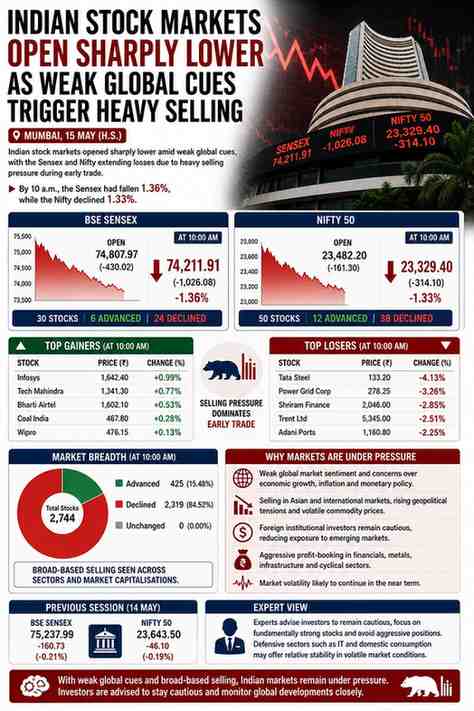
By 10 a.m., the Sensex had fallen 1.36 percent, while the Nifty declined 1.33 percent, reflecting the bearish undertone prevailing across domestic equities.
Weak Global Cues Trigger Heavy Selling
Analysts attributed the market decline primarily to weak global market sentiment and cautious investor positioning.
Concerns regarding international economic growth, global inflationary pressures and uncertainty in overseas equity markets reportedly influenced trading behaviour in domestic exchanges.
Investors appeared reluctant to make aggressive fresh purchases amid volatility in global financial markets.
The negative opening in Indian equities followed subdued trends in several Asian and international markets, where investors remained wary of rising geopolitical tensions, fluctuating commodity prices and concerns regarding monetary policy decisions in major economies.
Market experts noted that global risk-off sentiment often leads foreign institutional investors to reduce exposure to emerging markets, including India.
Sensex Extends Losses After Weak Opening
The BSE Sensex opened lower by 430.02 points at 74,807.97, reflecting immediate selling pressure at the start of the trading session.
As the market progressed, heavy selling intensified across multiple sectors, dragging the benchmark index further lower despite occasional recovery attempts through selective buying.
By 10 a.m., the Sensex had plunged 1,026.08 points and was trading at 74,211.91.
The sharp decline indicated widespread weakness among heavyweight stocks and blue-chip companies.
Out of the 30 constituent stocks in the Sensex, only six managed to trade in positive territory, while 24 stocks faced sustained selling pressure.
The sharp imbalance highlighted the dominance of bearish sentiment during early trading hours.
Nifty Falls Below Key Psychological Levels
The NSE Nifty also witnessed significant weakness and opened sharply lower by 161.30 points at 23,482.20.
Selling pressure intensified soon after the opening bell, dragging the index to an intraday low of 23,317.10.
By 10 a.m., the Nifty was trading at 23,329.40, down by 314.10 points from the previous close.
The broader weakness in the Nifty reflected declines across banking, metal, infrastructure and financial stocks.
Among the 50 constituent stocks of the Nifty index, only 12 stocks traded in positive territory, while 38 stocks remained under pressure.
Market participants observed that the decline below important support levels could increase short-term volatility if selling pressure continues.
IT Stocks Offer Limited Support to Market
Despite the broader weakness, a few information technology and telecom stocks managed to remain in positive territory during early trade.
Among the top gainers were Infosys, Tech Mahindra, Bharti Airtel, Coal India and Wipro.
These stocks registered gains ranging between 0.13 percent and 0.99 percent by 10 a.m.
Analysts suggested that defensive buying in select IT and telecom counters helped limit deeper losses in the broader market.
Technology stocks often attract investor interest during periods of uncertainty because of their export-oriented business models and comparatively stable earnings outlook.
However, the gains in these select stocks were insufficient to offset broader market weakness.
Metal and Infrastructure Stocks Witness Sharp Declines
Several heavyweight stocks from the metal, infrastructure and financial sectors emerged among the top losers during early trade.
Major decliners included Tata Steel, Power Grid Corporation of India, Shriram Finance, Trent Limited and Adani Ports and Special Economic Zone.
These stocks recorded declines ranging between 2.25 percent and 4.13 percent during the session.
Analysts noted that cyclical sectors such as metals and infrastructure are particularly sensitive to concerns over global economic slowdown and commodity demand.
Weak sentiment in these sectors contributed significantly to the broader market decline.
Broader Market Breadth Remains Weak
Market breadth remained heavily negative during the early session, indicating widespread selling pressure across the broader market.
A total of 2,744 stocks were actively traded during early dealings.
Of these, only 425 stocks advanced and traded in the green, while 2,319 stocks declined and remained in negative territory.
The large number of declining stocks highlighted the extent of weakness across sectors and market capitalisations.
Analysts observed that such weak market breadth often reflects risk aversion among investors and broad-based profit booking.
The mid-cap and small-cap segments also reportedly witnessed selling pressure alongside frontline indices.
Investors Remain Cautious Amid Volatility
Market participants remained cautious amid continued volatility and uncertainty in domestic and global financial markets.
Experts noted that investors are closely tracking international developments, commodity price movements and macroeconomic indicators for further direction.
The ongoing volatility has also increased uncertainty regarding near-term market trends.
Traders reported that intermittent buying attempts failed to generate sustained recovery because of persistent selling pressure from institutional investors.
Some analysts believe that markets may remain volatile in the short term until stronger domestic or global triggers emerge to improve investor confidence.
Previous Session Also Ended in Negative Territory
The weakness in Sunday’s trading session followed a negative close in the previous trading session on Friday.
On Friday, the Sensex had closed 160.73 points lower, or 0.21 percent down, at 75,237.99.
Similarly, the Nifty had ended the session lower by 46.10 points, or 0.19 percent, at 23,643.50.
Analysts noted that continued weakness over consecutive sessions suggests that investors remain cautious despite intermittent recovery attempts.
Profit-booking at higher levels and concerns regarding valuations have also contributed to recent market fluctuations.
Global Economic Concerns Continue to Influence Markets
Global economic uncertainty continues to remain one of the primary drivers influencing equity market movements worldwide.
Investors across markets are monitoring developments related to inflation trends, interest rate expectations, crude oil prices and geopolitical tensions.
Fluctuations in international bond yields and currency markets have also affected investor sentiment in emerging economies.
Experts believe that foreign institutional investment flows may remain volatile until there is greater clarity regarding global monetary policy and economic growth prospects.
Indian markets, despite strong long-term fundamentals, remain sensitive to overseas developments because of increasing integration with global financial systems.
Analysts Advise Cautious Trading Strategy
Market experts advised investors to remain cautious amid ongoing volatility and avoid aggressive speculative positions.
Analysts suggested focusing on fundamentally strong companies and maintaining disciplined investment strategies during uncertain market conditions.
Some brokerage firms indicated that sectors linked to domestic consumption, technology and defensive businesses may continue to attract selective investor interest.
However, experts warned that short-term fluctuations are likely to continue if global weakness persists.
Investors have also been advised to monitor upcoming corporate earnings, economic indicators and international market developments for further cues.
Market Outlook Remains Volatile
The sharp decline in Indian equities during early trade reflects continued nervousness among investors amid weak global cues and broad-based selling pressure.
Although selective buying in technology and telecom counters offered limited support, the overall market tone remained negative through the first half of the session.
Analysts believe the direction of the market in coming sessions will depend heavily on global sentiment, institutional investment flows and macroeconomic developments.
For now, investors appear focused on capital preservation and cautious positioning as volatility continues to dominate trading activity across domestic equity markets.
Key Insights
- The sharp decline in benchmark indices reflects the continued sensitivity of Indian equities to global market sentiment, particularly amid uncertainty in international financial markets, commodity prices, and interest-rate expectations.
- Broad-based selling, with declining stocks significantly outnumbering advancing shares, indicates weak overall market breadth rather than isolated sector-specific pressure, suggesting cautious investor sentiment in early trade.
- The resilience shown by information technology stocks such as Infosys and Wipro may indicate selective defensive positioning by investors, as export-oriented IT companies can sometimes benefit from currency fluctuations and global outsourcing demand.
- Losses in sectors linked to infrastructure, metals, ports, and finance highlight investor concerns around cyclical and economically sensitive industries during periods of global uncertainty and risk aversion.
- Continued volatility in the market suggests that traders are closely monitoring international cues, including global equity performance, crude oil prices, geopolitical developments, and signals from major central banks regarding monetary policy.
- The decline comes despite intermittent buying support, indicating that institutional and retail investors remain cautious about near-term market direction after recent highs in benchmark indices.
- Sustained weakness in broader market participation can affect investor confidence in the short term, particularly among retail investors who have significantly increased participation in Indian equities over the past few years.
- Market corrections of this nature are also closely watched for their potential impact on foreign institutional investment flows, which remain an important driver of liquidity and valuation trends in Indian capital markets.
- The movement of indices early in the trading session may influence sector rotation strategies, with investors potentially shifting toward relatively defensive sectors such as technology, telecom, and consumption-linked stocks until broader stability returns.
- Analysts will likely monitor whether the current weakness remains a short-term reaction to external cues or develops into a deeper correction driven by earnings concerns, global economic slowdown fears, or sustained foreign fund outflows.
Inputs & Images: Hindusthan Samachar
Edited By: Akshaya Polepalli
Also Read: 117 Ama Bus Services Hit Across Bhubaneswar as Employees Protest Over Unpaid Salaries
Follow us on google news: Click Here