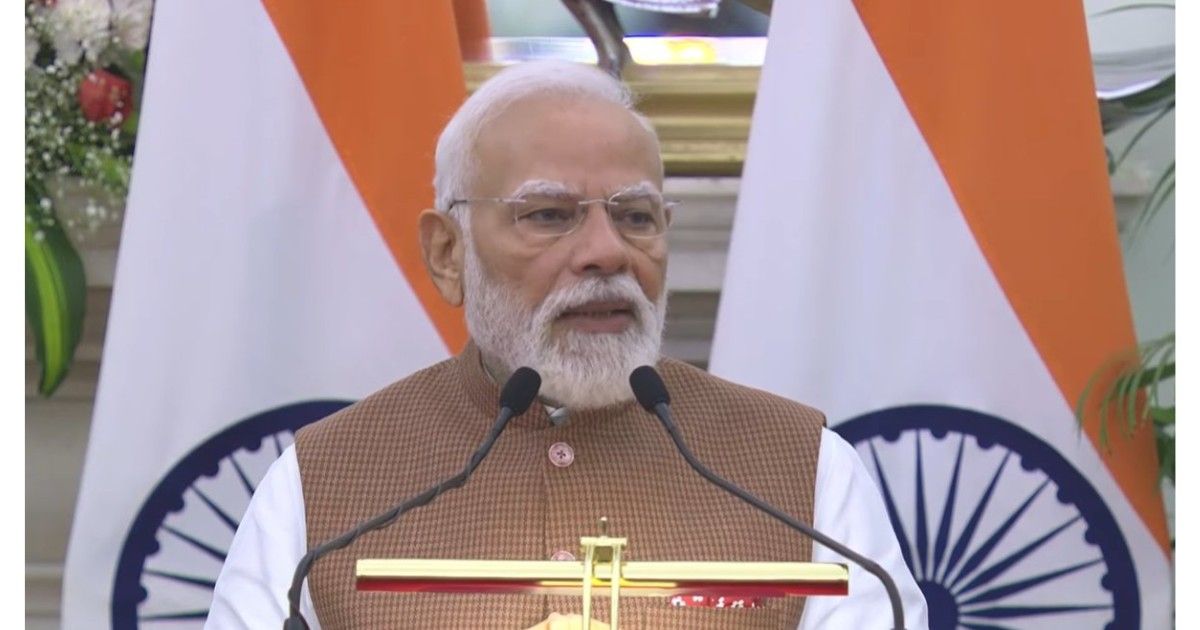
New Delhi, March 27: Narendra Modi on Thursday extended his congratulations to Balendra Shah following his swearing-in as Nepal’s new Prime Minister. In a message shared on social media platform X, Modi acknowledged the public mandate behind Shah’s appointment and expressed optimism about advancing the longstanding relationship between India and Nepal.
The development comes at a significant moment in regional diplomacy, as both countries seek to reinforce cooperation across economic, cultural, and strategic domains.
Key Highlights of the Message
In his message, Modi described Shah’s appointment as a reflection of the confidence placed in him by the people of Nepal. He also conveyed his intention to work closely with the new leadership in Kathmandu to strengthen bilateral ties.
The Prime Minister emphasised that India and Nepal share a deep-rooted and multifaceted relationship, adding that further strengthening these ties would benefit citizens of both countries.
The communication underlines India’s readiness to engage with Nepal’s new government at a time when regional partnerships are increasingly important.
Official Statement
In the post, Narendra Modi said he looked forward to working with Balendra Shah to take the “historic, close and multifaceted” India–Nepal relationship to “even higher levels.”
He highlighted that cooperation between the two nations is built on shared interests and mutual benefit, signalling continuity in India’s foreign policy approach toward its Himalayan neighbour.
Political Transition in Nepal
Balendra Shah assumed office as Nepal’s 47th Prime Minister following the outcome of the March 2026 general elections. His party, the Rastriya Swatantra Party, secured a strong mandate, paving the way for a leadership transition.
The election results have been closely watched in the region, given Nepal’s strategic location and its historical ties with neighbouring countries, particularly India and China.
Shah’s rise to the top political office marks a new phase in Nepal’s governance, with expectations of policy continuity alongside potential reforms.
India–Nepal Relations: Historical Context
India and Nepal share a unique relationship characterised by open borders, cultural linkages, and deep economic ties. The two countries have longstanding cooperation in areas such as trade, infrastructure, energy, and people-to-people exchanges.
The India–Nepal Treaty of Peace and Friendship of 1950 laid the foundation for close bilateral engagement, allowing free movement of people and goods across the border.
Over the years, the relationship has seen both collaboration and challenges, including occasional diplomatic sensitivities related to border issues and political developments.
Despite these complexities, both nations have consistently emphasised dialogue and cooperation as the basis for their engagement.
Focus Areas for Future Cooperation
Indian officials have indicated that New Delhi is keen to deepen engagement with Nepal’s new government across multiple sectors. These include:
- Economic cooperation: Enhancing trade and investment flows
- Connectivity projects: Expanding road, rail, and energy linkages
- People-to-people ties: Strengthening cultural and social exchanges
- Energy collaboration: Increasing cooperation in hydropower and electricity trade
Such initiatives are seen as mutually beneficial, contributing to regional stability and economic growth.
Public and Strategic Significance
For citizens of both countries, stronger India–Nepal relations can translate into improved economic opportunities, better connectivity, and enhanced cross-border collaboration.
The open border between India and Nepal facilitates movement for work, education, and trade, making bilateral relations particularly impactful at the grassroots level.
Strategically, maintaining stable ties with Nepal is important for India’s neighbourhood policy, while Nepal benefits from economic and infrastructural support from its southern neighbour.
Diplomatic Messaging and Regional Implications
Modi’s congratulatory message also carries diplomatic significance, reflecting India’s intent to maintain continuity in its engagement with Nepal despite leadership changes.
Such messages are often seen as signals of goodwill and readiness to collaborate, especially in regions where political transitions can influence foreign policy directions.
At the same time, both countries are expected to navigate existing sensitivities carefully, ensuring that cooperation continues without major disruptions.
Outlook Ahead
The appointment of Balendra Shah opens a new chapter in Nepal’s domestic politics and its external relations.
India’s early outreach, as reflected in Narendra Modi’s message, suggests a proactive approach to maintaining strong bilateral ties.
Going forward, the focus will likely be on translating diplomatic goodwill into concrete outcomes through joint initiatives and policy coordination.
The trajectory of India–Nepal relations under the new leadership will be closely watched, both within the region and internationally, as the two neighbours continue to build on their shared history and mutual interests.
Inputs & Images: Hindusthan Samachar
Edited By: Akshaya Polepalli
Also Read: Manoj Sinha Thanks Centre for ₹5,000 Crore Assistance to Jammu and Kashmir