Water crisis India worsens during the extreme summer season as cities face tanker shortages, water cuts, groundwater decline, and rising panic among residents.
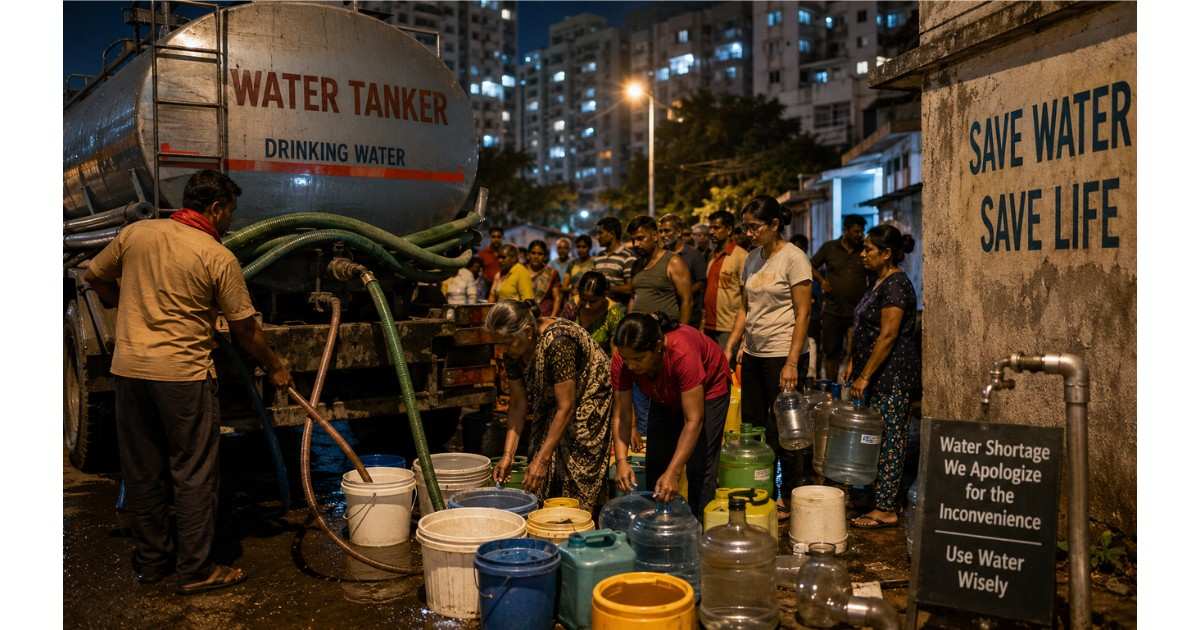
Tankers arriving at midnight, empty taps in residential colonies, and panic buying of bottled water are becoming common scenes across several cities as the water crisis India situation intensifies during peak summer months. From Delhi and Bengaluru to Hyderabad and parts of Maharashtra, millions of residents are struggling to access daily water supplies as rising temperatures and falling groundwater levels create severe shortages.
The water crisis India problem has become one of the most discussed public issues this summer because the shortages are directly affecting households, schools, offices, hospitals, and local businesses. In many urban areas, residents are waking up before sunrise just to store enough water for cooking, bathing, and cleaning. Social media platforms are filled with videos showing long lines near water tankers and heated arguments over limited water access.
Water Crisis India Creates Panic in Major Cities
Several state governments and municipal authorities have introduced emergency measures to manage the water crisis India challenge. Water tankers are being deployed to residential colonies, restrictions on non essential water usage are being enforced, and authorities are appealing to citizens to conserve every possible drop.
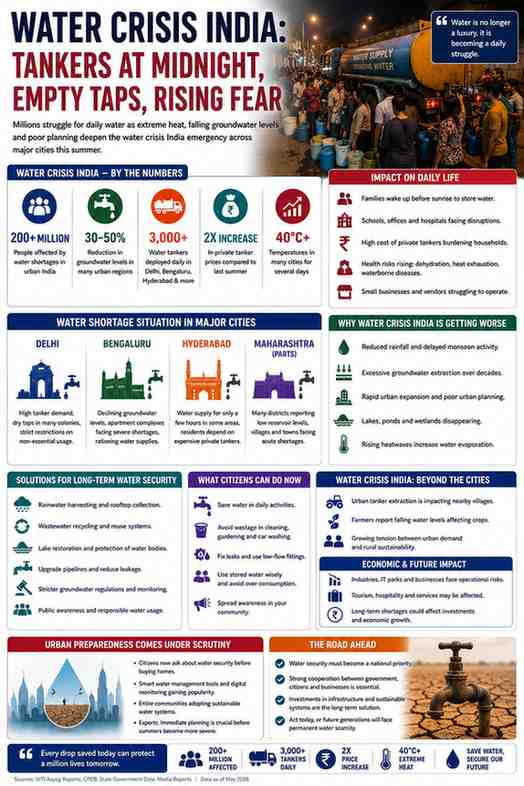
Delhi has witnessed rising demand for tanker services as temperatures continue to climb above normal seasonal levels. In Bengaluru, apartment complexes are reporting shortages due to declining groundwater reserves. Hyderabad residents in some neighborhoods say they are receiving water supplies for only a few hours every day, forcing families to depend on expensive private tankers.
Experts say the water crisis India problem is not only linked to extreme heatwaves but also to years of excessive groundwater extraction, poor rainwater harvesting systems, and rapid urban expansion. Cities are growing faster than their infrastructure, making it difficult for authorities to maintain stable water supplies during harsh summers.
Why the Water Crisis India Situation Is Becoming More Serious
Climate experts believe changing weather patterns are worsening the water crisis India issue every year. Reduced rainfall, delayed monsoon activity, and increasing heatwaves are placing additional pressure on reservoirs and underground water sources.
Groundwater levels in several states have reportedly fallen sharply over the last decade. Many cities depend heavily on underground reserves because rivers, lakes, and local reservoirs are unable to meet growing demand. Once groundwater levels fall below critical limits, recovery becomes difficult even after monsoon rains return.
Urban planning specialists also warn that uncontrolled construction is reducing natural recharge zones. Lakes and wetlands that once helped store rainwater are disappearing because of rapid development projects. This has increased dependence on water tankers and private suppliers in many metropolitan regions.
The water crisis India conversation is also triggering political debates. Opposition leaders in several states are criticizing local governments for poor planning and delayed infrastructure projects, while ruling parties argue that climate change and population growth are major contributing factors beyond immediate administrative control.
Families Struggle as Summer Shortage Disrupts Daily Life
The impact of the water crisis India emergency is especially severe for middle class and lower income families. Many households are spending large amounts of money on private tanker deliveries because municipal supplies are insufficient. In some areas, the prices of water tankers have doubled compared to previous summers.
Parents say school children are struggling in the extreme heat without reliable water access. Small businesses, restaurants, and street vendors are also reporting operational difficulties because daily activities require steady water supplies. Hospitals and healthcare facilities are closely monitoring sanitation conditions to avoid additional health risks during the shortage.
Doctors are warning residents to remain hydrated because extreme temperatures combined with limited water access can increase the risk of dehydration, heat exhaustion, and other medical emergencies. Elderly citizens and outdoor workers are considered particularly vulnerable during the current water crisis India conditions.
Social media users have also amplified public frustration by sharing viral videos of dry taps, crowded tanker queues, and residents protesting outside municipal offices. These visuals have increased national attention on the seriousness of the water shortage.
Can India Prevent Future Water Shortages?
Environmental experts believe long term planning is essential to reduce the water crisis India threat in future summers. Rainwater harvesting, lake restoration, improved pipeline systems, wastewater recycling, and stricter groundwater regulations are frequently suggested as critical solutions.
Several cities have already started awareness campaigns encouraging citizens to reduce unnecessary water consumption. Authorities are asking residents to avoid wasting water on vehicle washing, gardening, and excessive household usage during the peak shortage period.
Experts also stress that individual conservation efforts alone will not solve the water crisis India challenge unless large scale infrastructure reforms are implemented quickly. Investments in sustainable urban planning and water management systems are expected to become even more important as Indian cities continue expanding rapidly.
For millions of people across the country, the current summer is becoming a reminder that water security may soon become one of India’s biggest urban challenges. As temperatures remain dangerously high and groundwater reserves continue declining, concerns surrounding the water crisis India issue are likely to dominate public discussions throughout the season.
Water Crisis India Raises Questions About Urban Preparedness
The growing water crisis India situation is also changing the way citizens think about urban living and future city planning. Real estate experts say homebuyers are now asking developers detailed questions about groundwater availability, tanker dependency, and long term water security before purchasing apartments. Gated communities with strong rainwater harvesting systems are witnessing higher demand because buyers want protection from future shortages.
Technology companies are also entering the discussion by promoting smart water management tools designed to track daily consumption and reduce waste. Some apartment associations are installing digital monitoring systems to detect leakage and encourage responsible usage among residents. Environmental groups believe such innovations could help cities manage resources more efficiently if adopted on a larger scale.
Meanwhile, rural regions surrounding major cities are facing indirect pressure from the water crisis India emergency because urban tanker operators often source water from nearby villages. Farmers in several areas have raised concerns that excessive extraction is affecting agriculture and local drinking water reserves. This has created tension between urban demand and rural sustainability.
Economic analysts warn that repeated summer shortages could eventually impact productivity, tourism, and investment in major metropolitan areas. Companies operating in technology hubs and industrial zones require stable infrastructure, including reliable water access, to maintain business operations. Any prolonged disruption may create additional pressure on local administrations already struggling with rapid population growth.
As discussions continue across television debates, social media platforms, and policy meetings, the water crisis India problem is no longer viewed as a temporary seasonal inconvenience. Many experts now describe it as a long term national challenge requiring urgent cooperation between governments, urban planners, businesses, and citizens before future summers become even more difficult.
Without immediate reforms, the water crisis India emergency could transform from a seasonal concern into a permanent urban survival challenge for millions.
Key Insights
- The water crisis India situation is intensifying across major cities as extreme summer heat, falling groundwater levels, and rising urban demand create severe shortages.
- Cities including Delhi, Bengaluru, Hyderabad, and regions in Maharashtra are facing major water supply stress during peak summer months.
- Tankers arriving at midnight, empty taps, long queues, and panic buying of bottled water are becoming increasingly common scenes in affected residential areas.
- Millions of residents are struggling to secure enough water for daily activities such as cooking, bathing, cleaning, and sanitation.
- Social media platforms are amplifying public concern through viral videos showing tanker queues, dry taps, resident protests, and arguments over limited water supplies.
- Authorities in several states are deploying emergency tanker services, enforcing restrictions on non-essential water usage, and encouraging citizens to conserve water.
- Delhi is experiencing rising demand for tanker deliveries due to extreme temperatures, while Bengaluru apartment complexes are reporting shortages caused by declining groundwater reserves.
- Some neighborhoods in Hyderabad are receiving water for only a few hours each day, forcing residents to rely on costly private tanker services.
- Experts believe the water crisis India challenge is being driven not only by heatwaves but also by years of excessive groundwater extraction, weak rainwater harvesting systems, and uncontrolled urban expansion.
- Climate experts warn that changing weather patterns, reduced rainfall, delayed monsoons, and recurring heatwaves are worsening water shortages every year.
- Falling groundwater levels across multiple states are becoming a major concern because many cities depend heavily on underground reserves when rivers and reservoirs fail to meet demand.
- Urban planners argue that disappearing lakes, wetlands, and natural recharge zones caused by rapid construction are reducing cities’ ability to replenish groundwater naturally.
- The crisis is also triggering political debates, with opposition parties criticizing governments for inadequate infrastructure planning while authorities cite climate change and population growth as major challenges.
- Middle-class and lower-income families are among the worst affected because tanker prices in some regions have reportedly doubled compared to previous summers.
- Schools, hospitals, restaurants, small businesses, and street vendors are facing operational difficulties due to inconsistent water access.
- Doctors are warning citizens about dehydration, heat exhaustion, and sanitation-related health risks caused by the combination of extreme heat and limited water availability.
- Elderly people, outdoor workers, and children are considered especially vulnerable during the ongoing water shortage conditions.
- Environmental experts recommend long-term solutions including rainwater harvesting, wastewater recycling, lake restoration, improved pipeline systems, and stricter groundwater regulation.
- Authorities are encouraging citizens to avoid wasting water on vehicle washing, gardening, and excessive household usage during peak shortage periods.
- Real estate buyers are increasingly evaluating groundwater availability, tanker dependency, and rainwater harvesting systems before purchasing homes.
- Residential communities with strong water management infrastructure are witnessing higher demand because residents view water security as a major urban survival issue.
- Technology companies are promoting smart water management systems, leakage detection tools, and digital monitoring technologies to improve water efficiency in apartment complexes and urban communities.
- Rural areas surrounding major cities are also facing indirect pressure because tanker operators often extract water from nearby villages, creating tension between urban demand and agricultural sustainability.
- Economic analysts warn that repeated water shortages could eventually impact tourism, productivity, investment, and business operations in India’s major metropolitan hubs.
- The article positions water crisis India not as a temporary seasonal inconvenience, but as a long-term national urban infrastructure challenge requiring urgent cooperation between governments, businesses, planners, and citizens.
- A central theme throughout the article is that water security is rapidly emerging as one of India’s most serious future urban survival and sustainability concerns.
Edited By: Akshaya Polepalli
Also Read: Creator Economy India Growth: Why Gen Z Is Leaving Traditional Jobs for Creator Startups
Follow us on google news: Click Here