Omar Abdullah refuses to cut tricolour-themed ribbon at Kashmir Haat event, emphasising respect for national flag and protocol.
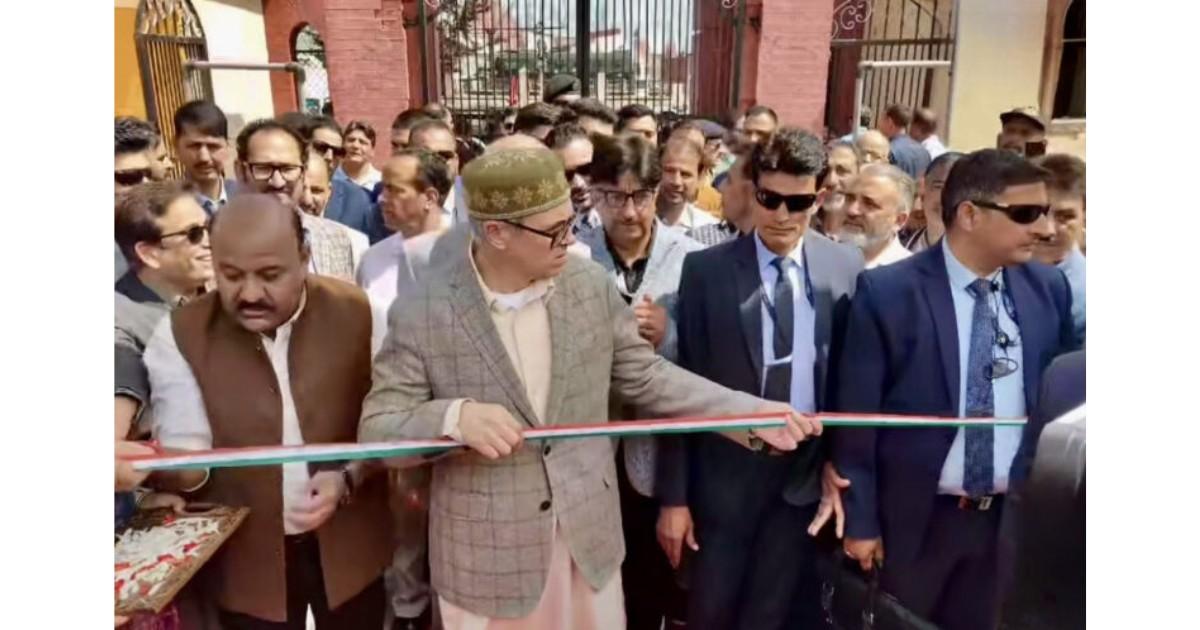
Jammu, April 15: Jammu and Kashmir Chief Minister Omar Abdullah on Wednesday declined to cut an inaugural ribbon designed in saffron, white, and green stripes—colours resembling the Indian national flag—during an official event in Jammu. Instead of proceeding with the customary ribbon-cutting ceremony, he chose to untie it and return it to the organisers, urging them to treat it with due respect.
The incident took place during the inauguration of the “Know Your Artisans” programme at Kashmir Haat, where the Chief Minister was present along with senior officials and dignitaries.
A Gesture Rooted in Symbolism
According to eyewitnesses and video footage that quickly circulated across social media platforms, Omar Abdullah approached the ribbon placed across the venue entrance before pausing upon noticing its tricolour-like design.
Rather than cutting it, he carefully untied the ribbon and handed it back to the organisers, reportedly advising them that such colours are associated with the national flag and should be handled with dignity and respect.
The gesture, though brief, drew immediate attention both at the venue and online, sparking conversations about the symbolic significance of the national flag and the protocols associated with its representation.
Event Proceeds Without Disruption
Following the brief interruption, the inauguration ceremony continued without any further issues. The Chief Minister proceeded to formally open the event and interact with participants, including artisans and stakeholders present at the venue.
The “Know Your Artisans” programme aims to promote traditional crafts and provide a platform for local artisans to showcase their work, reflecting the region’s rich cultural and artistic heritage.
Senior officials, including Deputy Chief Minister Surinder Choudhary and advisor Nasir Aslam Wani, were also present during the event.
Social Media Reaction and Public Discourse
The moment was captured on camera and quickly gained traction on social media, where it generated a range of responses. While some users praised the Chief Minister’s action as a mark of respect for the national flag, others engaged in discussions حول the interpretation of symbols and the appropriateness of using tricolour patterns in ceremonial decorations.
Observers noted that the Indian flag, commonly referred to as the Tricolour, holds deep national significance, and its usage is governed by specific guidelines under the Flag Code of India. While decorative use of similar colours is not uncommon, the resemblance in formal settings can sometimes raise questions about protocol.
The incident has, therefore, brought renewed focus on how national symbols are represented in public events and the importance of adhering to established norms.
Understanding the Protocol Around the Tricolour
India’s national flag is a symbol of sovereignty, unity, and pride. The Flag Code of India outlines clear rules regarding its display, usage, and treatment. It emphasizes that the flag should not be used in a manner that undermines its dignity or reduces it to a decorative element.
While the ribbon at the event was not an actual flag, its colour pattern closely mirrored the tricolour, which may have prompted the Chief Minister’s decision to avoid cutting it.
Experts point out that public figures often exercise caution in such situations to ensure that their actions align with both legal provisions and public sentiment.
Cultural Event Highlights Local Artisans
Despite the attention drawn by the ribbon incident, the primary focus of the event remained on the promotion of local artisans and crafts.
The “Know Your Artisans” initiative seeks to highlight the work of skilled craftsmen and women from across Jammu and Kashmir, offering them greater visibility and market opportunities. Exhibits at the event included traditional handicrafts, textiles, and other region-specific art forms.
Officials said such initiatives are crucial for preserving cultural heritage while also supporting livelihoods in the handicrafts sector, which plays a significant role in the region’s economy.
Leadership and Public Messaging
Political observers view Omar Abdullah’s action as a reflection of the sensitivity associated with national symbols in public life. Leaders often use such moments to convey broader messages about احترام, identity, and shared values.
By choosing not to cut the ribbon and instead returning it respectfully, the Chief Minister appeared to underscore the importance of treating symbols associated with the nation with care and consideration.
While interpretations of the gesture may vary, it has undeniably contributed to a wider conversation on civic awareness and the role of symbolism in governance.
Balancing Tradition and Protocol
Ribbon-cutting ceremonies are a standard feature of inaugurations across India, symbolizing the formal opening of an event or facility. However, the design and presentation of such ceremonial elements can sometimes intersect with cultural and national symbols.
The incident at Kashmir Haat highlights the need for organisers to be mindful of such overlaps and ensure that event arrangements align with both tradition and established guidelines.
Event planners and officials may increasingly exercise caution in the use of colours and symbols to avoid unintended controversies or misunderstandings.
Broader Implications
While the episode lasted only a few moments, its impact has extended beyond the event itself, prompting discussions on respect for national identity and the responsibilities of public institutions.
It also underscores how seemingly minor details in public events can carry significant symbolic weight, particularly in a country where national symbols are deeply revered.
The administration has not issued any formal statement regarding the incident, but sources indicated that the event was otherwise conducted smoothly and achieved its intended objectives.
A Symbolic Gesture Sparks Wider Reflection
The incident involving Chief Minister Omar Abdullah at the Kashmir Haat event serves as a reminder of the importance of sensitivity toward national symbols in public life. By opting to untie rather than cut a ribbon resembling the tricolour, he highlighted the need to uphold the dignity associated with such representations.
As conversations around the episode continue, it reinforces the broader principle that respect for national identity extends beyond formal observance to everyday actions and decisions in public spaces.
Inputs & Images: Hindusthan Samachar
Edited By: Akshaya Polepalli
Also Read: Machail Mata Yatra Begins in Kishtwar as Shrine Reopens with Mandatory Registration for Devotees