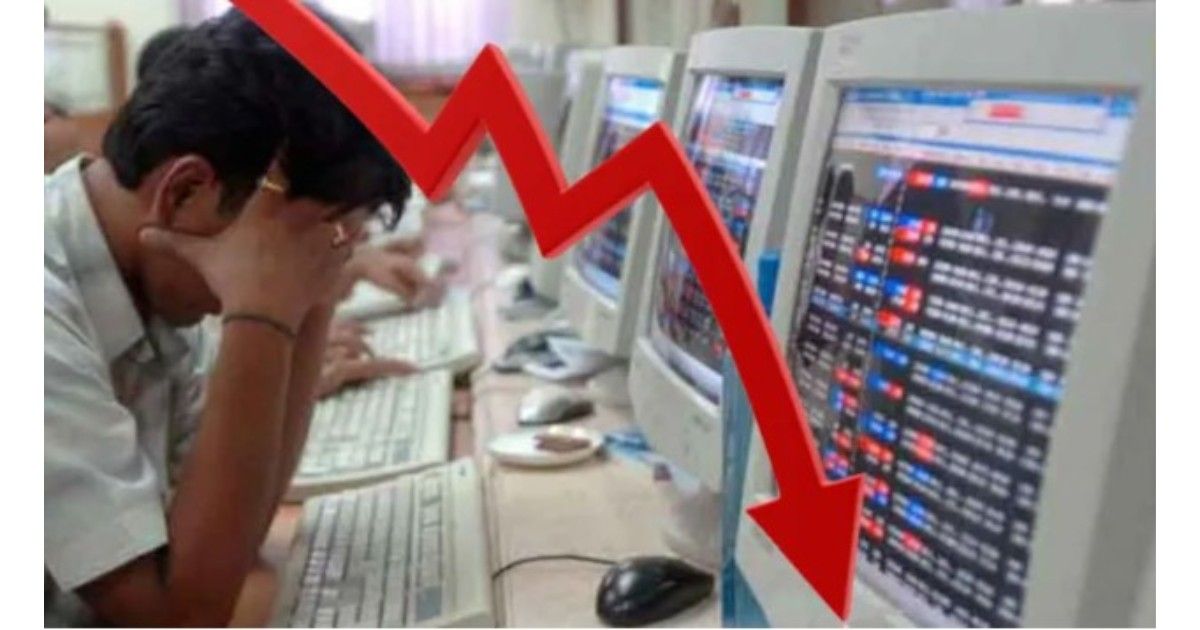
Indian stock market ends lower after a volatile session as Sensex and Nifty fall, wiping over ₹30,000 crore in investor wealth.
India’s equity markets closed in negative territory on Tuesday after a highly volatile trading session, with benchmark indices surrendering early gains amid sustained selling pressure in key sectors. The sharp swings during the day led to a notional erosion of more than ₹30,000 crore in investor wealth, reflecting cautious sentiment among market participants.
Benchmarks Reverse Early Gains to End in Red
The BSE Sensex opened lower at 77,094.79, down over 200 points, but quickly rebounded as buying interest emerged during the early hours of trade. The index surged to an intraday high of around 77,493, gaining nearly 400 points from its opening level.
However, the momentum proved short-lived. Selling pressure intensified in the afternoon session, dragging the index back into negative territory. The Sensex eventually settled at 76,886.91, registering a decline of 416.72 points, or 0.54 percent.
Similarly, the Nifty 50 mirrored the volatility. After opening at 24,049.90 and climbing to an intraday high of 24,181.80, the index lost steam and slipped below the crucial 24,000 mark. It closed at 23,995.70, down 97 points, or 0.40 percent.
Sectoral Drag: Banking, IT and Auto Stocks Weigh
The decline in headline indices was primarily driven by losses in banking, information technology, and automobile stocks. Heavyweight counters witnessed profit-booking after recent gains, contributing significantly to the downward pressure.
Among the notable laggards were Axis Bank, HCL Technologies, InterGlobe Aviation, Maruti Suzuki, and Shriram Finance, each declining between 2 percent and nearly 3 percent.
Public sector banking stocks and FMCG counters also remained under pressure, reflecting cautious investor positioning in rate-sensitive and consumption-driven sectors.
Energy and Metal Stocks Provide Support
Despite the broader weakness, gains in select sectors helped limit deeper losses. Energy, oil & gas, and metal stocks emerged as key outperformers during the session.
Leading the gains was Oil and Natural Gas Corporation, which surged over 5 percent. Other top gainers included Adani Enterprises, Coal India, Reliance Industries, and Nestlé India.
These stocks benefited from sector-specific tailwinds, including firm commodity prices and continued interest in infrastructure-linked plays.
Broader Markets Show Relative Strength
In contrast to benchmark indices, broader markets displayed resilience. The Nifty Midcap 100 index gained 0.28 percent, while the Smallcap 100 index advanced 0.42 percent.
Market breadth, however, remained slightly negative. Out of nearly 3,000 stocks traded on the National Stock Exchange, around 1,249 stocks ended higher, while 1,715 closed in the red.
This divergence suggests selective buying in mid- and small-cap segments, even as large-cap stocks faced selling pressure.
Investor Wealth Takes a Hit
The volatility in the market translated into a significant erosion of investor wealth. The total market capitalisation of companies listed on the Bombay Stock Exchange declined to approximately ₹466.94 lakh crore from about ₹467.26 lakh crore in the previous session.
This indicates a notional loss of nearly ₹32,000 crore for investors over the course of the trading day.
What Drove the Market Volatility?
Market analysts attributed the choppy session to a combination of domestic and global factors. Key drivers included:
- Profit-booking: Investors locked in gains following a recent market rally.
- Global cues: Mixed international signals kept sentiment cautious.
- Sectoral rotation: Capital shifted toward defensive and infrastructure-linked sectors.
The movement suggests that while bullish sentiment has not entirely faded, investors are becoming more selective and risk-aware.
Outlook: Cautious Optimism Ahead
Looking ahead, market participants are expected to closely monitor global economic trends, corporate earnings, and domestic macroeconomic indicators.
The current phase of volatility may persist in the near term, particularly as investors rebalance portfolios and react to evolving global cues. However, continued strength in broader markets and selective sectors could provide underlying support.
Markets End Weak but Selective Buying Persists
Tuesday’s session highlighted the fragile balance between optimism and caution in the Indian equity markets. While benchmark indices ended lower due to heavy selling in key sectors, resilience in mid- and small-cap stocks points to continued investor interest in selective opportunities.
Inputs & Images: Hindusthan Samachar
Edited By: Akshaya Polepalli
Also Read: India’s Foreign Secretary Vikram Misri to Visit Nepal for Key Diplomatic Talks on May 11–12
Follow us on google news: Click Here