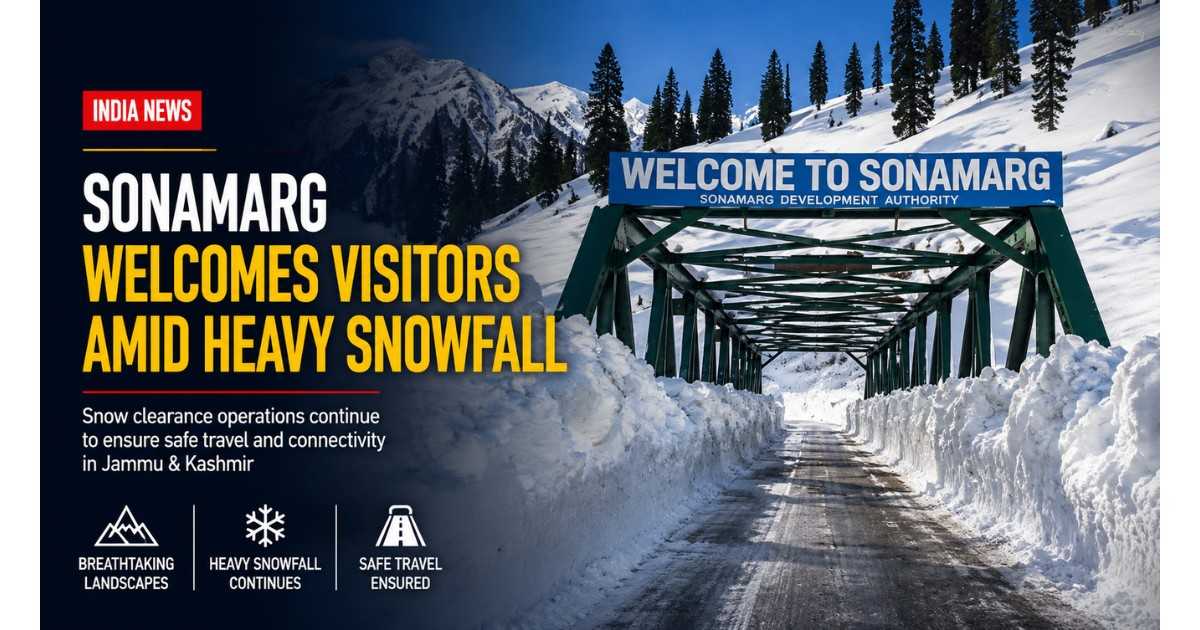
Authorities have reopened the SSG Road (Srinagar-Sonamarg-Gumri Road) for two-way traffic after snow clearance operations, while issuing safety guidelines and weather advisories for commuters.
The administration in Jammu and Kashmir has reopened the strategically important Srinagar-Sonamarg-Gumri (SSG) Road for two-way movement of medium and heavy motor vehicles following extensive snow clearance operations carried out along the route.
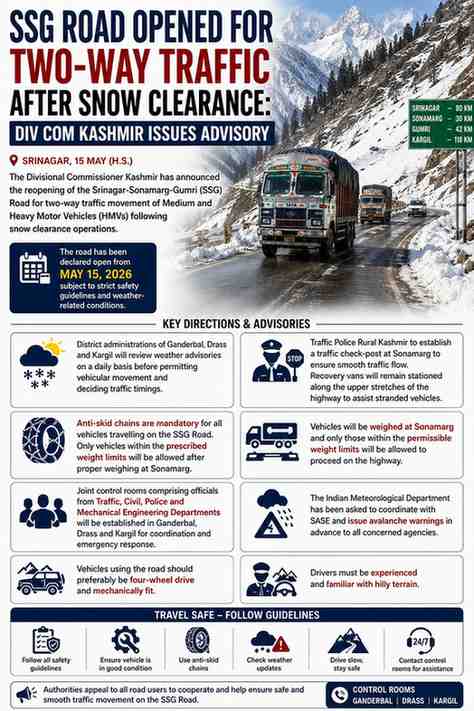
According to an official notification issued by the Office of the Divisional Commissioner Kashmir, the road was reopened from May 15, 2026, after authorities completed necessary restoration and safety assessments on the snow-bound stretches.
The reopening of the SSG Road is expected to significantly improve connectivity between Kashmir and Ladakh regions, particularly for transporters, essential supplies and commercial traffic.
Officials, however, clarified that vehicular movement on the route would remain subject to weather conditions, avalanche warnings and strict safety protocols.
Authorities Issue Strict Safety Guidelines
The Office of the Divisional Commissioner Kashmir stated that several precautionary measures have been put in place to ensure safe travel on the high-altitude route.
Authorities directed the district administrations of Ganderbal, Drass and Kargil to review weather advisories daily before allowing traffic movement and finalising timings for vehicular passage.
Officials said traffic movement would be regulated carefully because weather conditions in mountainous areas can change rapidly and create dangerous driving situations.
The administration also instructed travellers to strictly follow all traffic advisories and cooperate with officials deployed along the highway.
Traffic Police to Monitor Vehicle Movement
To manage the expected increase in traffic flow after the reopening, the authorities have directed Traffic Police Rural Kashmir to establish a dedicated traffic check-post at Sonamarg.
The checkpoint will monitor vehicle movement, regulate traffic flow and ensure compliance with safety instructions issued for the highway.
Officials said the Traffic Police would also coordinate with civil administration and emergency services to respond quickly in case of road blockages, vehicle breakdowns or weather-related emergencies.
Special monitoring arrangements have been planned because sections of the SSG Road remain vulnerable to snowfall, landslides and avalanches even during late spring and early summer months.
Recovery Vans and Emergency Support Arranged
Authorities stated that recovery vans would remain deployed along upper stretches of the highway to assist stranded or damaged vehicles.
Officials said these emergency arrangements are aimed at minimising disruptions and ensuring rapid assistance to motorists travelling through difficult terrain.
The administration also announced the establishment of joint control rooms involving officials from multiple departments, including Traffic, Civil Administration, Police and Mechanical Engineering.
These control rooms will operate in Ganderbal, Drass and Kargil to coordinate emergency response, traffic regulation and rescue operations if required.
Officials noted that coordinated communication between departments would be crucial in managing traffic movement safely on the mountainous highway.
Anti-Skid Chains Made Mandatory
As part of the advisory, the administration has made it compulsory for vehicles travelling on the SSG Road to use anti-skid chains.
Officials explained that slippery road conditions caused by residual snow, ice patches and wet surfaces can significantly increase the risk of accidents in hilly areas.
Authorities stressed that vehicles without proper anti-skid arrangements would not be permitted to proceed on the highway.
The order also specified that only vehicles within prescribed weight limits would be allowed after mandatory weighing procedures at Sonamarg.
This restriction aims to prevent excessive pressure on vulnerable road stretches and ensure safer vehicle movement through mountainous sections.
Preference for Four-Wheel Drive Vehicles
Authorities advised travellers to use four-wheel drive vehicles wherever possible while travelling on the SSG Road.
Officials said such vehicles are generally better equipped to handle steep gradients, slippery surfaces and difficult terrain commonly encountered along the highway.
Drivers were also advised to ensure that vehicles are mechanically fit before beginning the journey.
The administration further stressed that only experienced drivers familiar with mountain roads and adverse weather conditions should undertake travel on the route.
Experts noted that driving in high-altitude Himalayan terrain requires specialised handling skills because of sharp turns, narrow roads and rapidly changing weather patterns.
IMD and SASE to Issue Avalanche Warnings
The administration stated that the India Meteorological Department would coordinate with the Snow and Avalanche Study Establishment (SASE) to issue timely avalanche warnings for the region.
Officials said advance alerts would help authorities regulate traffic movement and prevent vehicles from entering vulnerable stretches during dangerous conditions.
Avalanche risks remain a major concern along several Himalayan roads connecting Kashmir and Ladakh, especially during periods of snowmelt and unstable weather.
Authorities emphasised that traffic movement could be temporarily suspended if weather forecasts indicate heightened risks to public safety.
Strategic Importance of the SSG Road
The Srinagar-Sonamarg-Gumri Road holds immense strategic and economic importance for Jammu and Kashmir and the Ladakh region.
The route serves as a key transportation corridor connecting the Kashmir Valley with Ladakh and facilitates movement of essential goods, fuel, construction material and commercial supplies.
The reopening of the highway is expected to provide major relief to transport operators and traders who rely on the route for logistical connectivity.
The road also supports tourism activity, particularly for travellers visiting Sonamarg, Drass and other high-altitude destinations.
Officials believe the reopening will help revive seasonal tourism and commercial movement after months of winter closure caused by heavy snowfall.
Snow Clearance Operations Faced Major Challenges
Authorities said reopening the highway required extensive snow clearance operations across difficult terrain and high-altitude sections.
Teams worked continuously to remove accumulated snow, restore road surfaces and ensure safe passage for vehicles.
Officials noted that weather conditions in mountainous areas often complicate restoration work because of fresh snowfall, ice formation and landslide threats.
Mechanical equipment, snow cutters and engineering teams were deployed to reopen critical stretches blocked during winter months.
The administration acknowledged the efforts of road maintenance teams, engineers, traffic personnel and disaster response units involved in restoring connectivity.
Weather Conditions to Determine Traffic Movement
Despite reopening the highway, authorities stressed that traffic movement would remain heavily dependent on weather conditions.
District administrations will review daily forecasts and coordinate with weather agencies before permitting vehicle movement on the road.
Officials warned that sudden snowfall, heavy rain or avalanche threats may require temporary suspension of traffic at short notice.
Travellers have therefore been advised to check official advisories before planning journeys on the SSG Road.
Authorities also requested commuters to avoid unnecessary travel during adverse weather conditions and maintain sufficient fuel, food and emergency supplies while travelling.
Connectivity Boost Expected for Kashmir and Ladakh
The reopening of the SSG Road is expected to significantly improve connectivity between Kashmir and Ladakh during the summer season.
Transporters, traders, local residents and tourism stakeholders have welcomed the restoration of the route after months of restricted movement.
Officials believe smoother transportation will support economic activity, tourism operations and supply chains across the region.
The administration reiterated its commitment to maintaining road safety and ensuring uninterrupted connectivity while prioritising public safety in vulnerable mountainous zones.
With traffic resuming after extensive snow clearance efforts, authorities continue to closely monitor weather developments and road conditions to ensure secure movement along one of the region’s most important highways.
Key Insights
- The reopening of the Srinagar-Sonamarg-Gumri (SSG) Road marks an important seasonal restoration of connectivity between Srinagar and the Ladakh region, particularly for freight movement, essential supplies, and inter-district transportation after prolonged winter disruption.
- The route serves as a strategically significant corridor linking Kashmir with Kargil and adjoining high-altitude areas, making timely reopening critical for economic activity, tourism, defence logistics, and local livelihoods in remote regions.
- Mandatory anti-skid chains, vehicle weight restrictions, and weather-based movement controls reflect the continuing risks associated with high-altitude Himalayan roads, where snow accumulation, avalanches, and landslides can rapidly alter driving conditions.
- The involvement of multiple agencies, including Traffic Police, Civil Administration, Mechanical Engineering Departments, and meteorological authorities, highlights the complex coordination required to maintain safe movement in mountainous terrain.
- Daily weather reviews by district administrations indicate an increasingly dynamic approach to road management in climate-sensitive regions, where authorities rely heavily on real-time weather and avalanche assessments before permitting traffic.
- The advisory encouraging four-wheel-drive vehicles and experienced drivers underscores persistent safety challenges on Himalayan roads, where mechanical failures or driver inexperience can lead to serious accidents and prolonged traffic disruptions.
- The establishment of joint control rooms and recovery infrastructure suggests lessons learned from previous seasonal closures and stranded-vehicle incidents, particularly during sudden weather deterioration in the Kashmir–Ladakh corridor.
- Improved operational readiness on the SSG Road may also support tourism flows toward Sonamarg, Drass, and Kargil during the summer season, contributing to regional economic activity after winter isolation.
- The dependence on advance avalanche warnings from meteorological and snow study agencies reflects the growing importance of scientific forecasting and disaster preparedness in managing transport infrastructure across fragile Himalayan ecosystems.
Inputs & Images: Hindusthan Samachar
Edited By: Akshaya Polepalli
Also Read: Calcutta High Court Stays Demolition of Illegal Building in Kolkata’s Tiljala Area
Follow us on google news: Click Here