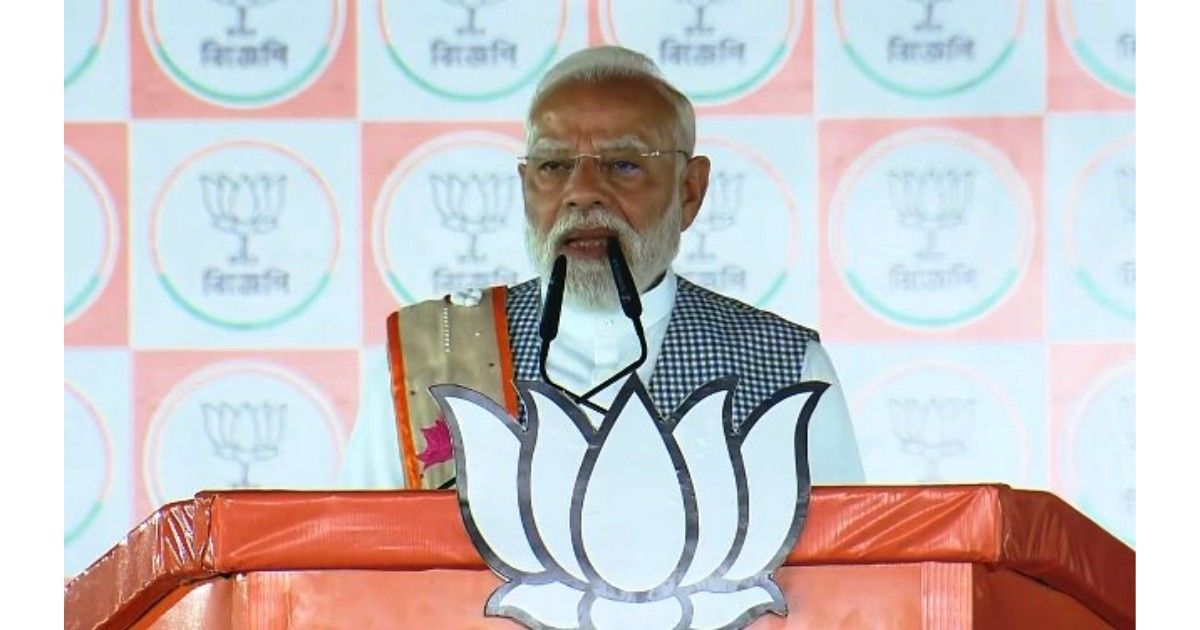
PM Modi addresses Barrackpore rally in West Bengal, targets TMC, promises jobs, safety, and BJP government after elections.
Prime Minister Narendra Modi on Monday asserted that Barrackpore—historically linked to the Indian Rebellion of 1857—would once again become a catalyst for change, this time in West Bengal’s political landscape.
Addressing a Vijay Sankalp rally, he positioned the region as the starting point for what he described as a decisive shift away from the rule of the All India Trinamool Congress (TMC), calling on voters to support the Bharatiya Janata Party (BJP) in the ongoing assembly elections.
“Will Return for Oath-Taking,” Says PM
Striking a confident tone, Modi told the gathering that he expects to return to the state after the results are declared—not for campaigning, but to attend the swearing-in ceremony of a BJP-led government.
He framed the elections as a turning point after what he termed 15 years of TMC governance, presenting the contest as an opportunity for voters to choose a new direction for the state.
“It is both my responsibility and commitment to serve Bengal and address its challenges,” he said, adding that he remains dedicated to the state’s development and security.
Roadshow Described as a “Pilgrimage”
Reflecting on his roadshow prior to the rally, the Prime Minister described the experience as a “tirtha-yatra” (pilgrimage), citing the large turnout of people who gathered along the route.
He said people had assembled early in the day to greet him and that the interaction reinforced his connection with citizens across the country. Modi also mentioned a supporter from Arambagh whom he could not meet and expressed intent to do so in the future.
Sharp Criticism of TMC Governance
During his address, Modi launched a strong critique of the ruling TMC government, alleging that industrial decline and law-and-order concerns have affected the state.
Referring to the Barrackpore industrial belt, he claimed that several jute mills had shut down in recent months, while illegal activities had increased. He described the situation as a breakdown of governance, using the term “maha-jangal raj.”
The TMC has not publicly responded to these specific claims at the time of reporting.
Focus on Women’s Safety and Law and Order
Highlighting issues of public safety, the Prime Minister appealed to women voters to support the BJP, stating that improved law enforcement would ensure greater security.
He urged voters to consider safety concerns while casting their ballots and said strengthening governance would be a priority if his party comes to power.
Employment and Welfare Promises
Modi also outlined a series of measures focused on employment and welfare, should the BJP form the government in West Bengal. These include:
- Filling vacant government posts through transparent recruitment
- Implementing time-bound hiring processes
- Extending benefits of the Seventh Pay Commission to employees
- Expanding rural employment opportunities
- Supporting street vendors through welfare schemes
He emphasised that job creation for local youth would be a key priority, particularly in addressing migration from the state.
Historical References and Political Messaging
Invoking the legacy of Syama Prasad Mukherjee, Modi recalled Bengal’s historical contribution to national politics and linked it to the ideological roots of the BJP.
He also referenced the abrogation of Article 370, stating it fulfilled one of Mukherjee’s long-standing visions, and suggested that similar transformative steps could be taken for Bengal’s development.
Appeal to Protect Cultural Identity
The Prime Minister raised concerns about demographic changes and the preservation of cultural identity, particularly in Kolkata. He urged citizens to unite in safeguarding the city’s character and heritage.
He also criticised past promises of transforming Kolkata into a global city, arguing that development goals had not been achieved.
Call for Unity and “Vande Mataram” Spirit
Concluding his speech, Modi invoked the patriotic slogan “Vande Mataram,” urging people to adopt its spirit as a guiding force for the state’s progress.
He linked Bengal’s development to the broader national vision of a developed India by 2047, positioning the election as part of a larger transformation agenda.
Barrackpore as Symbolic Launchpad for Political Change
By highlighting Barrackpore’s historical significance and connecting it to present-day politics, the Prime Minister sought to energise supporters and present the BJP as a viable alternative in West Bengal.
With polling underway and results expected in early May, the state remains a key battleground, and the outcome is likely to have significant political implications beyond the region.
Inputs & Images: Hindusthan Samachar
Edited By: Akshaya Polepalli
Also Read: IPL 2026 Orange Cap Race Heats Up as Abhishek Sharma Takes Lead; Rabada Climbs in Purple Cap Standings