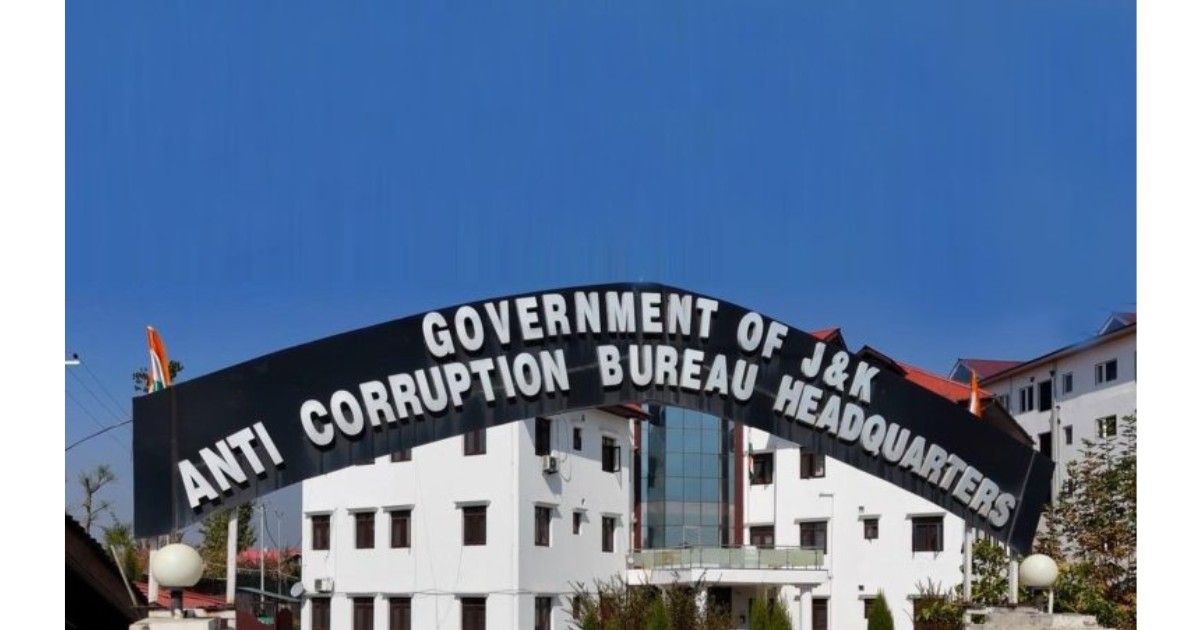
In a significant anti-corruption action, the Anti-Corruption Bureau (ACB) of Jammu and Kashmir has arrested two officials from the Public Works Department (PWD) in Baramulla district for allegedly accepting a bribe of ₹13,000. The arrests were made during a carefully planned trap operation, following a complaint regarding delayed payment clearance linked to a bribe demand.
The accused officials, identified as Mushtaq Ahmad, a Senior Assistant, and Farooq Ahmad, a Junior Assistant, were posted in the PWD (R&B) Mechanical Division in North Kashmir’s Baramulla. According to officials, both were caught “red-handed” while accepting the bribe amount from the complainant.
The case has once again highlighted persistent concerns about corruption in public service delivery systems and the role of vigilance agencies in addressing such practices.
Complaint Triggered by Delay in Payment Clearance
The case came to light after a complainant approached the Anti-Corruption Bureau through its helpline on April 6, 2026. The complainant, who works as a manager for a private firm registered on the Government e-Marketplace (GeM) portal, alleged that officials had demanded a bribe in exchange for releasing a pending payment.
According to the complaint, the firm had successfully participated in a government tender floated by the PWD Mechanical Division for the supply of a customized vehicle designed for live fish transportation. The firm emerged as the lowest bidder (L1) and subsequently delivered the vehicle to the Department of Fisheries in Bandipora.
Following the delivery, the firm raised the bill through the GeM portal and also submitted physical documentation to the concerned department. Although the bill was processed and forwarded to the accounts section, the payment was allegedly withheld for several days.
The complainant claimed that despite completing all procedural requirements, the officials deliberately delayed the payment and demanded ₹13,000 as a bribe to release the funds.
Verification Leads to FIR Under Prevention of Corruption Act
Upon receiving the complaint, the Anti-Corruption Bureau initiated a discreet verification process to assess the authenticity of the allegations. Officials confirmed that the claims were found to be prima facie substantiated, prompting immediate legal action.
A formal case was registered as FIR No. 01/2026 at the ACB Police Station in Baramulla. The charges were filed under Section 7 of the Prevention of Corruption Act, 1988 (as amended in 2018), along with Section 61 of the Bharatiya Nyaya Sanhita, 2023.
These provisions deal with the illegal act of public servants demanding or accepting gratification in exchange for performing official duties, and they carry stringent penalties upon conviction.
Trap Operation Leads to Arrest of Accused Officials
Following the registration of the case, ACB officials devised a trap to catch the accused in the act. During the operation, the complainant was instructed to hand over the bribe amount under the supervision of the investigating team.
The trap was executed successfully, and both officials were apprehended on the spot while allegedly accepting the bribe money. The ACB team completed all necessary legal formalities before taking the accused into custody.
Officials confirmed that the marked currency notes used in the operation were recovered from the accused, strengthening the case against them.
Investigation Ongoing, More Details Expected
The Anti-Corruption Bureau has stated that further investigation into the case is currently underway. Authorities are examining whether similar practices may have been carried out in other transactions within the department.
Investigators are also expected to scrutinize official records, communication logs, and financial transactions to build a comprehensive case.
The ACB has reiterated its commitment to ensuring transparency and accountability in government functioning and has urged citizens to come forward with complaints against corrupt practices.
Public Advisory: Reporting Corruption Made Easier
In its statement, the Anti-Corruption Bureau emphasized that both giving and accepting bribes are punishable offenses under the law. It encouraged citizens to report any instances of corruption through multiple channels provided by the agency.
Residents of Jammu and Kashmir can report grievances or corruption-related complaints via:
- Toll-free helpline: 1800-180-7152
- WhatsApp number: 9419678060
- Satark Nagrik Mobile App
- Email: director.vigilance@jk.gov.in
The agency assured that all complaints would be treated confidentially and acted upon promptly.
Broader Context: Corruption in Public Procurement Systems
The case sheds light on vulnerabilities within public procurement and payment systems, where delays in processing bills can sometimes be exploited for illegal gains. Despite the introduction of digital platforms like the GeM portal to enhance transparency, instances of manual intervention in payment processes continue to pose challenges.
Experts note that while digitization has reduced direct human interaction in many areas, systemic loopholes still allow opportunities for corruption, particularly in departments dealing with contracts, procurement, and financial approvals.
The incident underscores the importance of strengthening oversight mechanisms and ensuring strict enforcement of anti-corruption laws.
Impact on Governance and Public Trust
Cases of bribery not only affect individual businesses and citizens but also undermine public trust in government institutions. Delays in payment can have significant financial implications for private firms, especially small and medium enterprises that rely on timely payments to sustain operations.
By taking swift action in this case, the Anti-Corruption Bureau aims to send a strong message that corrupt practices will not be tolerated and that accountability will be enforced.
Need for Systemic Reforms and Vigilance
While enforcement actions are crucial, experts emphasize the need for systemic reforms to prevent corruption at its source. Measures such as fully automated payment systems, real-time tracking of bills, and reduced discretionary powers can help minimize opportunities for malpractice.
Regular audits, strict monitoring, and increased transparency in departmental processes are also essential to build a robust governance framework.
Public awareness and citizen participation play a key role in this process. Encouraging individuals to report corruption without fear of retaliation can significantly strengthen anti-corruption efforts.
Conclusion: Strong Message Against Corruption
The arrest of two PWD officials in Baramulla by the Anti-Corruption Bureau marks a significant step in the ongoing fight against corruption in Jammu and Kashmir. The case highlights both the challenges and the progress in ensuring accountability within public institutions.
As the investigation continues, authorities are expected to take further action based on the findings, reinforcing the message that misuse of public office for personal gain will face strict legal consequences.
For citizens and businesses alike, the incident serves as a reminder of the importance of vigilance and the role of institutional mechanisms in safeguarding transparency and integrity in governance.
Inputs & Images: Hindusthan Samachar
Edited By: Akshaya Polepalli