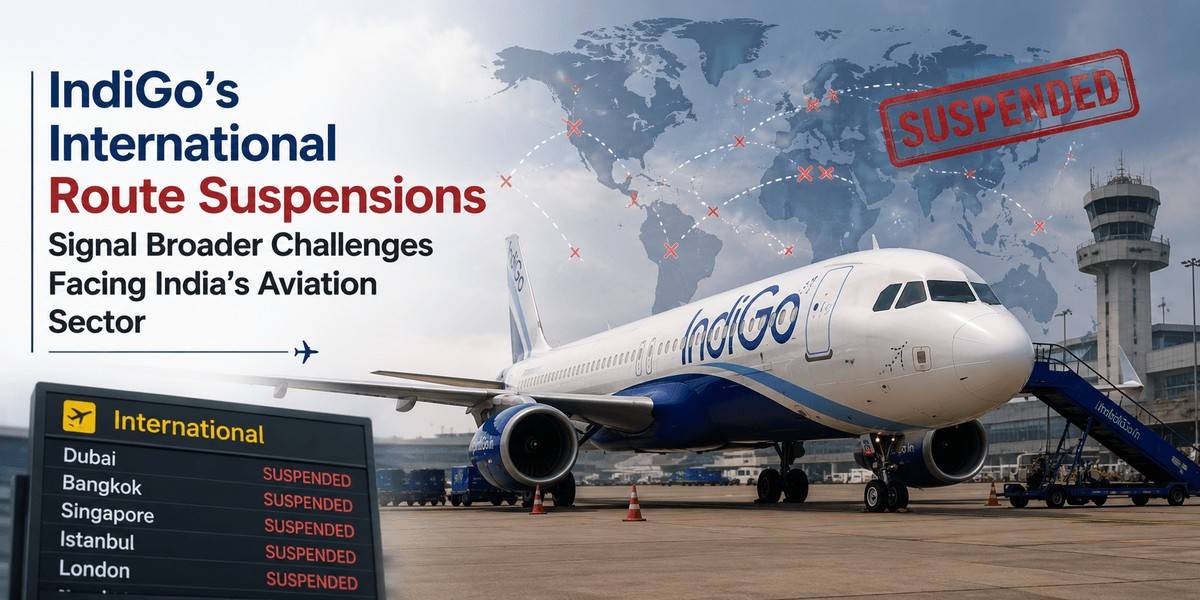
Rising fuel costs, currency pressures, and shifting demand patterns are forcing airlines to rethink growth strategies despite strong passenger numbers.
India’s largest airline, IndiGo, has announced the temporary suspension of flights to six international destinations between July and September, citing higher operating costs and weaker seasonal demand. While the move affects only a small portion of the carrier’s international network, industry observers say it reflects deeper structural challenges confronting India’s aviation sector.
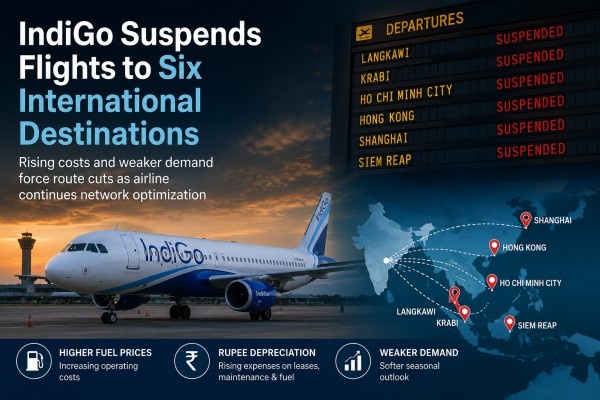
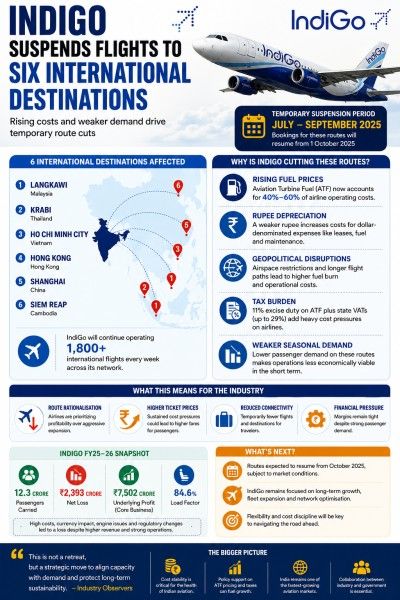
The suspended routes—Langkawi, Krabi, Ho Chi Minh City, Hong Kong, Shanghai, and Siem Reap—have raised questions about the sustainability of airline expansion in an environment marked by volatile fuel prices, geopolitical uncertainty, and increasing operational expenses.
Though IndiGo has emphasized that it will continue operating more than 1,800 international flights per week and plans to resume the affected services from October, the decision has sparked a broader discussion across the aviation industry about profitability, resilience, and future growth.
The route suspensions were first highlighted in industry discussions following reports that IndiGo was undertaking a network optimization exercise to align capacity with market conditions.
Award-winning aviation journalist Tarun Shukla noted that the airline’s latest decision follows earlier international service reductions, including routes to Copenhagen and Manchester.
“After Copenhagen, Manchester, IndiGo announces more international flight cuts,” Shukla observed, adding that services to Langkawi, Krabi, Ho Chi Minh City, Hong Kong, Shanghai, and Siem Reap would remain suspended until September before bookings resume from October.
The airline maintains that the move is temporary and intended to manage costs during a period of softer demand and rising operational pressures.
Industry Reactions
The announcement has reignited concerns about the economic realities facing airlines operating in one of the world’s fastest-growing aviation markets.
According to Thejeshwar Reddy B, Chairman and Managing Director of Hirola Infotech Solutions Pvt Ltd, Hirola Infra, and Easy Gentech Innovations Pvt Ltd, the challenges extend far beyond a single airline or route network.
“Major Indian carriers—including Air India, IndiGo, SpiceJet, and Akasa Air—have issued a stark warning to the government: stabilize Aviation Turbine Fuel (ATF) prices, or brace for massive operational scale-backs and grounded flights,” he wrote.
Reddy highlighted the growing burden of fuel costs, noting that ATF now accounts for between 40% and 60% of airline operating expenses. He also pointed to geopolitical tensions that have increased fuel consumption through longer flight paths and the tax burden imposed through excise duties and state-level VATs.
“The financial burden will inevitably fall on passengers. We are looking at a near future of reduced flight frequencies, canceled routes, and soaring ticket prices,” he warned.
His concerns mirror a growing sentiment across the industry that cost pressures are increasingly shaping airline network decisions.
Financial analyst and investment banking professional Ashish Shetty offered additional insight into the economics behind airline profitability, using IndiGo’s recent financial performance as an example.
“IndiGo carried 12.3 crore passengers in FY25-26 and still posted a loss of ₹2,393 crore,” Shetty noted.
According to his analysis, several factors converged simultaneously to create financial strain. These included a significant depreciation of the rupee against the U.S. dollar, aircraft groundings linked to Pratt & Whitney engine issues, and the impact of new labor regulations.
“Forex losses alone amounted to ₹7,357 crore in one year,” Shetty observed, emphasizing that many of the airline’s largest expenses—including aircraft leases, maintenance contracts, and fuel purchases—are denominated in dollars while revenue is largely earned in rupees.
Perhaps most significantly, Shetty argued that headline losses can sometimes obscure underlying operational performance.
“The core business was healthy. The headline said loss. The business said profit. Two completely different stories in the same company in the same year,” he wrote.
His assessment highlights the distinction between operational demand and financial sustainability—an increasingly important consideration for airline executives navigating uncertain market conditions.
What This Means for the Industry
The suspension of six international routes may appear modest on the surface, but it reflects a broader shift occurring across global aviation.
Airlines are increasingly prioritizing profitability and operational efficiency over aggressive capacity expansion. Rather than maintaining every route regardless of performance, carriers are becoming more willing to adjust networks in response to changing market conditions.
For Indian aviation, the challenge is particularly complex. Passenger demand remains strong, international travel continues to recover, and India’s long-term growth potential remains widely recognized. Yet airlines are simultaneously confronting elevated fuel costs, currency volatility, aircraft availability constraints, and regulatory pressures.
The result is an environment where growth alone does not guarantee profitability.
As Shetty’s analysis suggests, airlines can achieve high passenger volumes and healthy load factors while still struggling financially due to external variables beyond their control.
At the same time, Reddy’s observations underscore growing concerns that structural cost issues could eventually affect connectivity, ticket pricing, and route availability across the industry.
Future Outlook
Despite current challenges, industry experts do not view IndiGo’s route suspensions as a retreat from international expansion.
Instead, many see the decision as a pragmatic response to short-term economic realities. The airline continues to invest in fleet expansion and international growth, while maintaining one of the largest route networks in the region.
However, the discussion surrounding these suspensions has highlighted several issues likely to shape the sector’s future, including fuel taxation, foreign exchange exposure, fleet reliability, and operational efficiency.
If fuel prices stabilize and demand strengthens in the coming months, airlines may regain confidence in expanding capacity. Conversely, prolonged cost pressures could prompt further route rationalization across the industry.
For policymakers, the debate may also renew calls for reforms aimed at reducing aviation costs and improving the competitiveness of Indian carriers in international markets.
Key Takeaways
- IndiGo will temporarily suspend flights to six international destinations between July and September.
- The airline cited rising operating costs and weaker seasonal demand as key reasons.
- Aviation experts believe the move reflects wider industry challenges rather than route-specific issues.
- Fuel costs, currency depreciation, taxation, and operational disruptions continue to pressure airline profitability.
- Industry observers expect airlines to remain focused on network optimization and financial sustainability in the near term.
IndiGo’s decision to temporarily suspend flights to six international destinations represents more than a seasonal network adjustment. It serves as a reminder that even market-leading airlines must continuously balance growth ambitions with economic realities.
The broader discussion sparked by industry observers and business leaders points to a sector navigating a complex mix of opportunities and challenges. While passenger demand remains robust, profitability is increasingly influenced by factors ranging from fuel prices and currency movements to geopolitical developments and regulatory changes.
As India’s aviation market continues its rapid evolution, the ability of airlines to adapt to these pressures may prove just as important as their ability to attract passengers.