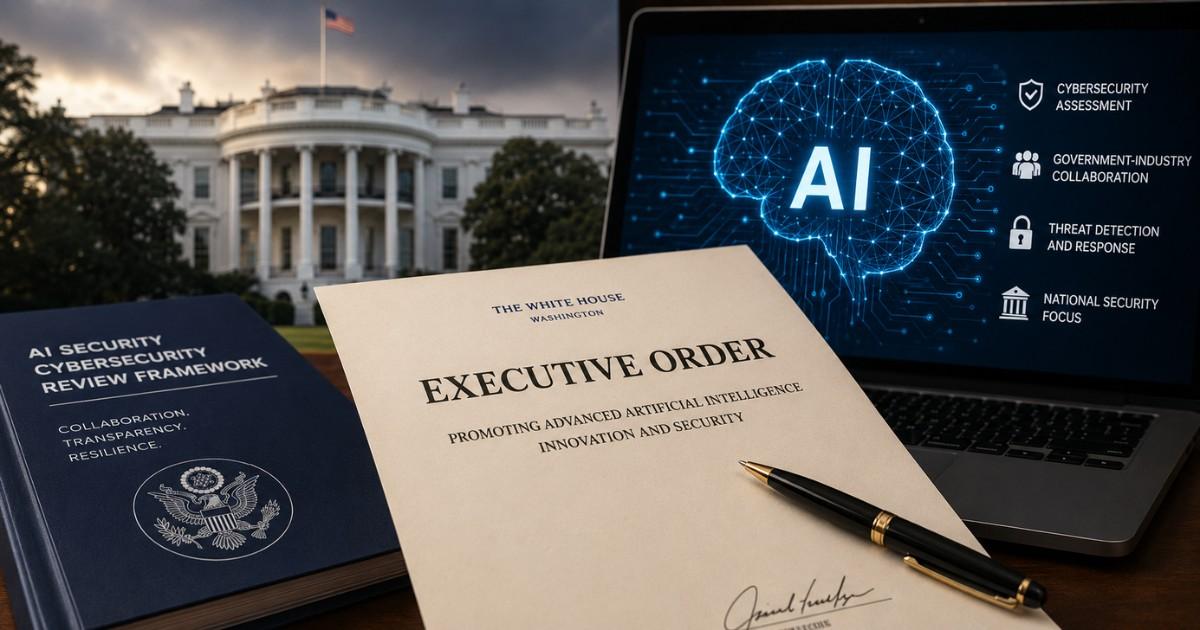
The debate over artificial intelligence regulation in the United States has entered a new phase following a White House executive order focused on AI security risks and cybersecurity preparedness. Signed by President Donald Trump, the order directs federal agencies to work alongside AI developers to assess the cybersecurity capabilities and vulnerabilities of advanced AI models before they reach the public.
Unlike previous regulatory proposals that sparked concerns about government intervention in AI development, the new framework stops short of imposing mandatory licensing or approval requirements. Instead, it relies on voluntary participation from AI companies while creating new mechanisms for government-industry collaboration on emerging cyber threats.
The move arrives at a time when frontier AI systems are demonstrating increasingly sophisticated capabilities, including the ability to identify software vulnerabilities, automate cyber operations, and potentially influence critical infrastructure security.
Background
The discussion gained momentum after reports from Reuters, Bloomberg, Politico, and CNBC revealed details of the administration’s executive order titled Promoting Advanced Artificial Intelligence Innovation and Security.
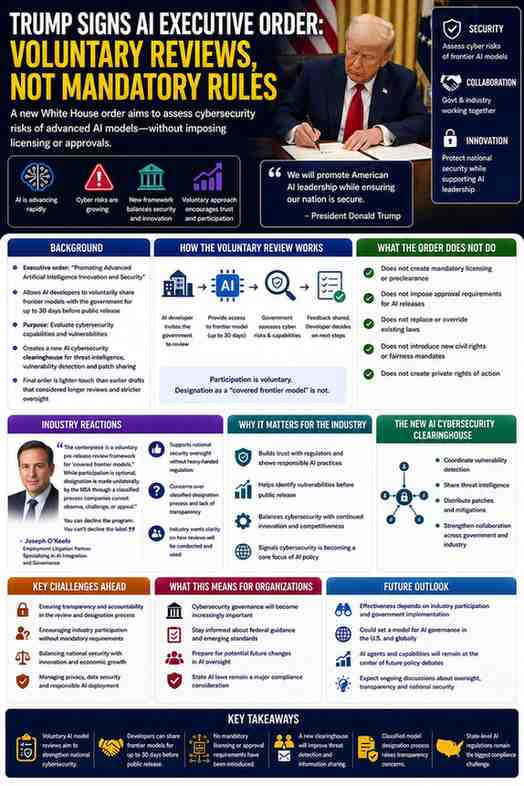
Under the order, developers of advanced AI systems can voluntarily provide federal agencies with access to newly developed models for up to 30 days before public release. The objective is to evaluate whether these systems possess advanced cyber capabilities that could create national security risks.
The framework also establishes plans for a new cybersecurity clearinghouse that would coordinate vulnerability detection, threat intelligence sharing, and patch distribution efforts among government agencies and industry stakeholders.
Notably, the final version of the order is viewed as less restrictive than earlier proposals. Reports indicate that previous drafts contemplated longer review periods and more extensive government oversight. The administration ultimately chose a voluntary approach, reflecting ongoing tensions between national security priorities and concerns that excessive regulation could hinder AI innovation.
Industry Reactions
Legal and AI governance professionals have been closely examining the implications of the executive order.
According to Joseph O’Keefe, Employment Litigation Partner specializing in AI integration and governance, the order represents a significant attempt to establish national security oversight over frontier AI systems without creating a formal regulatory approval process.
“The centerpiece of the EO is a voluntary pre-release review framework for ‘covered frontier models,’ which are the most advanced AI systems designated by the NSA through a classified benchmarking process,” O’Keefe explained.
He noted that developers may provide government agencies with access to advanced models before broader deployment, a response that follows growing concerns about AI systems capable of autonomously identifying and exploiting software vulnerabilities.
O’Keefe also highlighted what he views as one of the order’s most controversial elements: the classification mechanism itself.
“While participation in the voluntary program is optional, the designation of a ‘covered frontier model’ is made unilaterally by the NSA through a classified process that companies cannot observe, challenge, or appeal,” he said.
The distinction between voluntary participation and mandatory classification has already become a focal point for legal experts and technology policy observers.
As O’Keefe summarized, “You can decline the program. You can’t decline the label.”
Another aspect drawing attention is the administration’s explicit effort to avoid introducing licensing requirements for AI developers. The executive order specifically states that it should not be interpreted as creating mandatory governmental licensing, permitting, or preclearance obligations for AI releases.
This provision appears designed to reassure AI companies and investors who have argued that excessive regulation could undermine U.S. competitiveness in the global race for AI leadership.
At the same time, cybersecurity experts view the creation of a dedicated AI cybersecurity clearinghouse as recognition that advanced AI systems are becoming increasingly intertwined with national infrastructure and digital security.
The order’s emphasis on cyber resilience suggests policymakers are becoming more concerned about AI’s potential role not only as a defensive tool but also as an offensive capability in future cyber conflicts.
What This Means for the Industry
The executive order illustrates a broader policy trend emerging across major economies: governments are seeking greater visibility into advanced AI development without imposing comprehensive regulatory frameworks that could slow innovation.
For AI developers, the voluntary review system may provide an opportunity to build trust with regulators while demonstrating responsible deployment practices. Participation could also help companies identify vulnerabilities before public release, reducing reputational and operational risks.
However, questions remain about how much influence government agencies will ultimately have over model deployment decisions and whether voluntary programs could gradually evolve into stronger oversight mechanisms.
The order also leaves several important issues unresolved. According to O’Keefe, the framework does not introduce civil rights protections, algorithmic fairness requirements, mandatory reporting obligations, federal preemption of state AI laws, or private rights of action.
As a result, organizations deploying AI systems must continue navigating a fragmented regulatory environment shaped largely by state-level legislation.
For enterprises, investors, and compliance teams, this means cybersecurity governance may become a growing priority even as broader AI regulation remains unsettled.
Future Outlook
The effectiveness of the executive order will likely depend on whether major AI developers choose to participate and how federal agencies implement the review process.
If leading AI companies embrace the framework, it could establish a model for collaborative security oversight that balances innovation with risk management. Such an outcome could influence future AI governance efforts both in the United States and internationally.
On the other hand, concerns surrounding classified model designations, transparency, and accountability may intensify if companies perceive the process as opaque or inconsistent.
The executive order also signals that cybersecurity is becoming one of the central policy lenses through which governments evaluate advanced AI technologies. Future debates may increasingly focus on model capabilities, infrastructure protection, and cyber defense rather than solely on issues such as bias, misinformation, or workplace automation.
Conclusion
President Trump’s latest AI executive order represents an attempt to navigate one of the technology industry’s most difficult balancing acts: encouraging innovation while addressing emerging national security risks.
By relying on voluntary participation instead of mandatory approvals, the administration has adopted a lighter-touch approach than many observers expected. Yet the creation of new review mechanisms and cybersecurity infrastructure demonstrates that policymakers are becoming more proactive in monitoring the capabilities of advanced AI systems.
As AI models continue to grow more powerful, the debate over how much oversight is necessary—and who should provide it—is likely to remain one of the defining technology policy discussions of the decade.
Key Takeaways
- The White House has introduced a voluntary AI cybersecurity review framework for advanced models.
- AI developers may submit frontier models for up to 30 days of government cybersecurity assessment before release.
- The executive order explicitly avoids mandatory licensing or preclearance requirements.
- A new AI cybersecurity clearinghouse will coordinate vulnerability detection and threat response efforts.
- Experts are raising concerns about the classified process used to designate “covered frontier models.”
- State-level AI regulations remain the primary compliance challenge for many organizations.