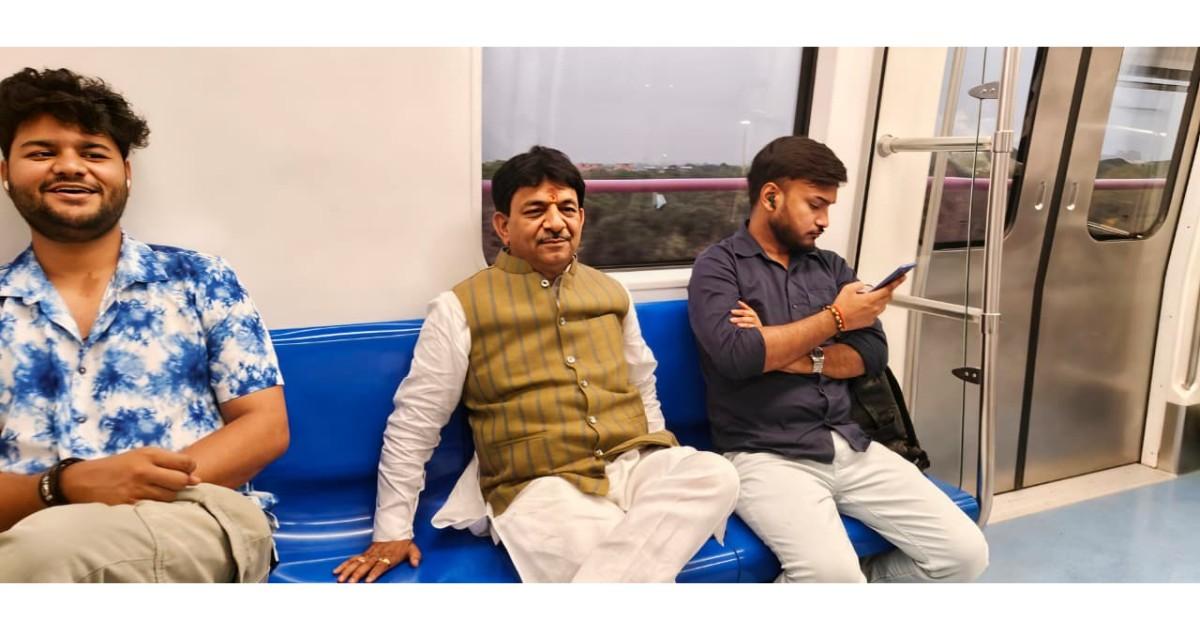
Uttar Pradesh Minister Kapil Dev Agarwal travelled by Metro and Namo Bharat Train from Delhi to Meerut, citing PM Narendra Modi’s appeal to conserve fuel, reduce pollution and promote public transport.
Uttar Pradesh Minister Kapil Dev Agarwal travelled from New Delhi to Meerut using the Metro and Namo Bharat Train network, aligning with Prime Minister Narendra Modi’s appeal encouraging citizens to conserve fuel, reduce pollution and make greater use of public transportation.
The minister’s journey has drawn attention as an example of public representatives adopting environmentally conscious commuting practices at a time when the government continues to promote sustainable mobility and energy conservation across the country.
Kapil Dev Agarwal, who serves as the Minister of State (Independent Charge) for the Vocational Education, Skill Development and Entrepreneurship Department in the Uttar Pradesh government, said the Prime Minister’s message was not limited to saving petrol and diesel but represented a broader vision connected to environmental protection and responsible resource management.
According to the minister’s official itinerary, he arrived at Indira Gandhi International Airport in New Delhi during the evening and proceeded directly to the airport Metro station instead of using a private vehicle.
From Terminal 3 Metro Station, he travelled to Sarai Kale Khan Railway Station using the Delhi Metro network. He later boarded the Namo Bharat rapid rail service and travelled onward to Meerut, eventually reaching Modipuram station.
The minister’s decision to commute through public transportation was presented as a symbolic effort to encourage wider public participation in reducing fuel consumption and traffic congestion in urban areas.
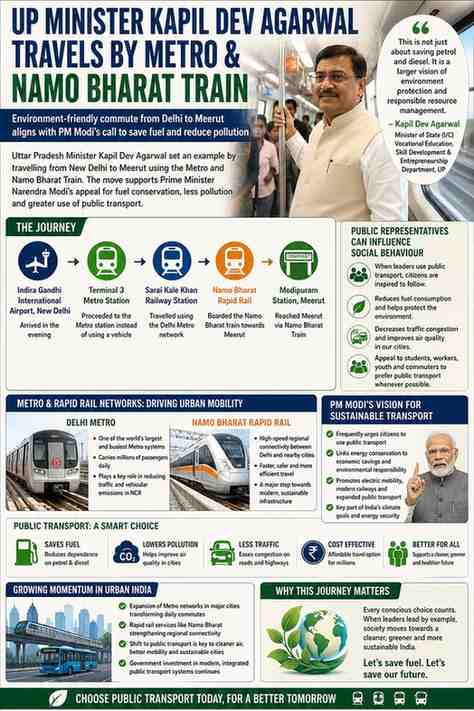
Public Representatives Can Influence Social Behaviour, Says Minister
Speaking about the journey, Kapil Dev Agarwal said public representatives should actively participate in initiatives aimed at environmental protection and sustainable transportation because their actions can send a strong message to society.
He stated that when elected leaders and government officials use public transport systems such as metro rail, buses and rapid rail corridors, citizens may feel more encouraged to adopt similar practices in their daily lives.
According to the minister, reducing dependence on private vehicles can significantly decrease fuel usage while also helping cities address rising levels of air pollution and traffic pressure.
He added that Prime Minister Modi’s larger vision includes preserving natural resources for future generations and encouraging responsible energy consumption across all sectors of society.
The minister also appealed to students, workers, youth and regular commuters to make use of public transportation systems for short-distance and routine travel whenever possible.
Metro and Rapid Rail Networks Emerging as Key Urban Mobility Solutions
The minister’s journey also highlighted the growing role of Metro rail systems and the Namo Bharat rapid rail corridor in improving regional connectivity across northern India.
The Namo Bharat Train, previously referred to as the Regional Rapid Transit System (RRTS), has been developed to provide faster and more efficient travel between Delhi and nearby urban centres, including Meerut.
The service is designed to reduce road congestion while offering commuters a modern alternative to private transport. Government authorities have repeatedly projected the rapid rail system as a major component of India’s future urban transportation infrastructure.
Similarly, the Delhi Metro continues to remain one of the country’s most widely used public transportation systems, carrying millions of passengers daily and playing a central role in reducing traffic and vehicular emissions in the National Capital Region.
Transport experts have often noted that wider public adoption of mass transit systems can contribute significantly to lowering carbon emissions and improving urban air quality.
PM Modi Has Repeatedly Advocated Sustainable Transport
Prime Minister Narendra Modi has frequently urged citizens to adopt environmentally sustainable habits, including the increased use of public transport and reduced fuel consumption.
In recent speeches and public outreach campaigns, Modi has linked energy conservation to both economic savings and environmental responsibility. The government has also promoted electric mobility, railway modernization and expanded public transport infrastructure under various national development initiatives.
Officials have argued that increased reliance on public transportation can help India reduce fuel imports, decrease congestion in major cities and support broader climate goals.
The Centre has simultaneously expanded investment in Metro projects, high-speed rail systems and regional transit corridors across several states.
The minister’s journey from Delhi to Meerut was therefore viewed by observers as a practical endorsement of these larger policy priorities.
Public Transport Use Gains Momentum in Urban India
Urban planners and transport authorities have increasingly emphasized the importance of shifting commuters away from private vehicles and toward mass transit systems.
Indian cities continue to face challenges related to traffic congestion, rising vehicle ownership and deteriorating air quality. Experts believe that better adoption of integrated public transportation systems can ease pressure on urban infrastructure while improving mobility efficiency.
The expansion of metro rail networks in cities such as Delhi, Bengaluru, Mumbai, Hyderabad and Lucknow has already transformed commuting patterns for millions of residents.
Rapid rail services such as Namo Bharat are expected to further strengthen regional connectivity by significantly reducing travel time between major urban centres.
Government officials have also pointed out that public transportation offers a cost-effective travel option for ordinary citizens while helping lower overall energy consumption.
Environmental Concerns Continue to Drive Policy Push
India’s growing focus on public transportation is also closely tied to environmental concerns and climate-related commitments.
Air pollution remains a serious challenge in several metropolitan regions, particularly during peak traffic periods. Experts have repeatedly stressed that reducing the number of private vehicles on roads is essential to improving urban air quality.
Authorities have therefore promoted initiatives encouraging the use of public transit, carpooling and non-motorised transportation.
The government has additionally invested in cleaner fuel technologies, electric mobility infrastructure and modern railway systems as part of a broader strategy to reduce emissions.
Kapil Dev Agarwal’s public transport journey comes amid these continuing efforts to create greater awareness around sustainable commuting practices.
Namo Bharat Corridor Seen as Symbol of Modern Infrastructure
The Namo Bharat rapid rail project has been projected as a major milestone in India’s transportation modernization efforts.
The corridor aims to provide high-speed regional connectivity between Delhi and nearby cities through advanced rail infrastructure, modern stations and reduced travel durations.
Officials believe such projects can boost economic activity, improve regional integration and reduce the burden on existing road networks.
The Delhi-Meerut corridor in particular has attracted significant public attention because of its potential to transform daily commuting for thousands of passengers travelling between the National Capital Region and western Uttar Pradesh.
The system has also been presented as an example of India’s push toward technologically advanced and environmentally sustainable transport infrastructure.
Minister Appeals for Wider Public Participation
Kapil Dev Agarwal reiterated that conserving fuel and protecting the environment require collective participation from citizens across all sections of society.
He said adopting public transportation systems is not only beneficial for the environment but can also help families reduce transportation expenses amid fluctuating fuel prices.
The minister further emphasized that small behavioural changes, when adopted on a large scale, can collectively produce significant national benefits in terms of energy conservation and environmental sustainability.
He urged citizens to support public transport initiatives and make conscious efforts to reduce unnecessary private vehicle usage whenever practical alternatives are available.
The minister’s journey has since been widely discussed on social media and among political circles as an example of symbolic participation in the government’s sustainability campaign.
As India continues expanding its metro rail and rapid transit infrastructure, public representatives using these services may increasingly become part of broader efforts to encourage behavioural change and promote environmentally responsible commuting habits across the country.
Inputs & Images: Hindusthan Samachar
Edited By: Akshaya Polepalli
Also Read: CBSE Class 12 Results 2026 Declared: Pass Percentage Drops to 85.20%, Girls Continue to Outperform Boys
Follow us on google news: Click Here