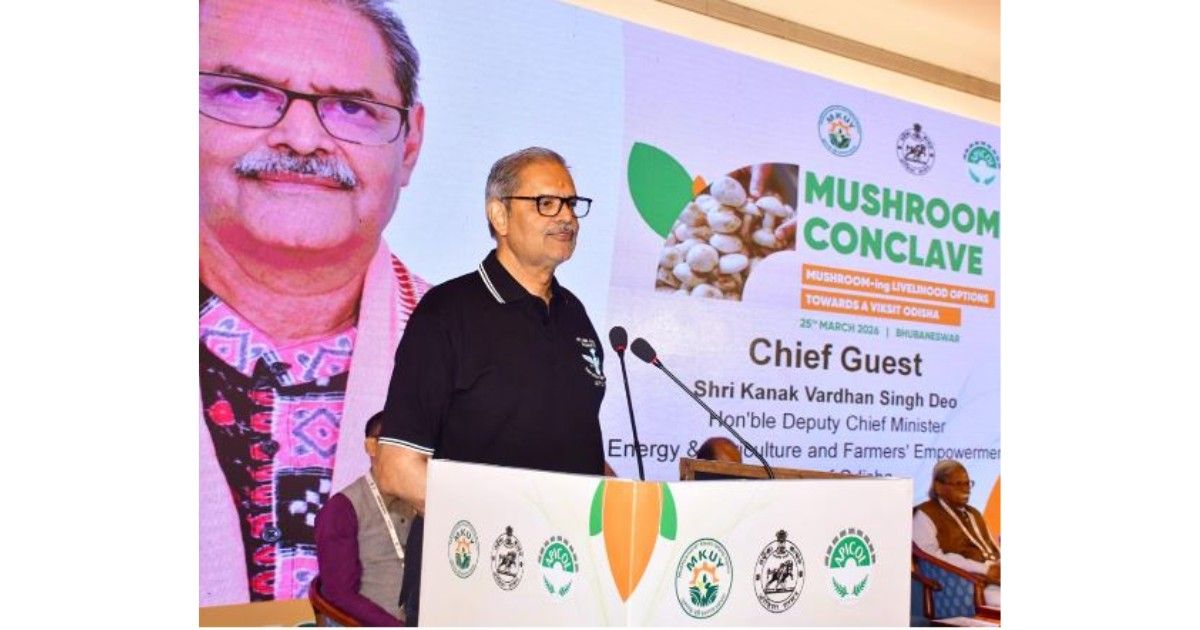
The event in Bhubaneswar focused on expanding mushroom cultivation as a sustainable and profitable livelihood option, with government support and industry participation.
The Mushroom Conclave 2026 was held in Bhubaneswar on Wednesday, bringing together policymakers, scientists, and farmers to explore the growing potential of mushroom cultivation in Odisha. The event aimed to promote the sector as a viable source of income and entrepreneurship under the state’s broader agricultural development strategy.
Organised by the Agricultural Promotion and Investment Corporation of Odisha Limited, the conclave was themed “Mushrooming Livelihood Options Towards a Viksit Odisha,” highlighting the role of agri-based enterprises in rural economic growth.
Key Announcements and Highlights
Speaking at the event, Deputy Chief Minister Kanak Vardhan Singh Deo said Odisha has emerged as a significant contributor to India’s mushroom production, accounting for nearly 11% of the national output.
He described mushrooms as a nutrient-rich food option with low fat and cholesterol levels, adding that their cultivation is environmentally sustainable and aligns with organic farming practices.
The government is actively supporting the sector through the Mukhyamantri Krushi Udyog Yojana, which provides financial assistance to farmers and entrepreneurs. During the conclave, officials also launched a new APICOL website and issued approvals to producers for setting up mushroom production and spawn units.
Focus on Technology and Market Linkages
The conclave featured multiple technical sessions covering advanced cultivation techniques, post-harvest management, and value addition. Experts discussed ways to improve productivity and strengthen supply chains to ensure better returns for farmers.
Commissioner-cum-Secretary of the Department of Agriculture & Farmers’ Empowerment, Sachin Ramchandra Jadhav, highlighted that mushroom farming requires relatively less water and offers quicker returns compared to many traditional crops.
Growing Sector Backed by Data
Officials shared that Odisha has produced around 63,000 metric tonnes of mushrooms in the current year. The state has also approved 1,207 farmers to establish mushroom-related enterprises, including spawn production and processing units for varieties such as paddy straw, oyster, and button mushrooms.
Out of these, 207 entrepreneurs have already received subsidies, indicating increasing adoption of mushroom cultivation as a business opportunity.
Why This Matters
Mushroom cultivation is gaining attention as a low-investment, high-return activity that can be practiced even on small landholdings. It requires less water and space, making it particularly suitable for regions facing resource constraints.
For farmers, especially in rural and peri-urban areas, the sector offers an alternative income stream and reduces dependence on seasonal crops. The focus on value addition and market access could further enhance profitability.
Broader Context
Odisha’s push toward mushroom farming aligns with its efforts to diversify agriculture and promote allied activities. Institutions like the Odisha University of Agriculture and Technology are supporting research and training to improve cultivation practices.
The participation of over 170 delegates, including scientists, entrepreneurs, and farmer groups, reflects growing interest in building a structured and market-driven ecosystem for the sector.
Conclusion
The Mushroom Conclave 2026 underscored Odisha’s strategy to expand income opportunities through sustainable agriculture. With policy support, technical training, and increasing market demand, mushroom cultivation is expected to play a larger role in the state’s rural economy in the coming years.
Inputs & Images: Hindusthan Samachar
Edited By: Akshaya Polepalli
Also Read: Box Office BLAST: Dhurandhar 2 Crosses ₹800 Crore Worldwide, Eyes ₹1,000 Crore Club