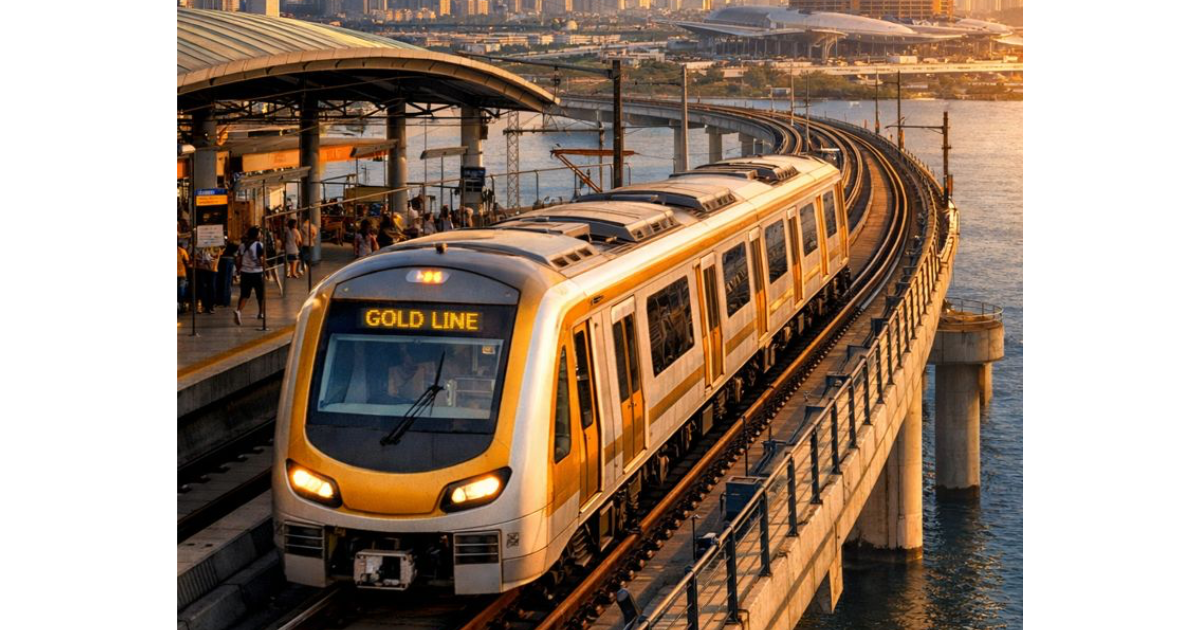
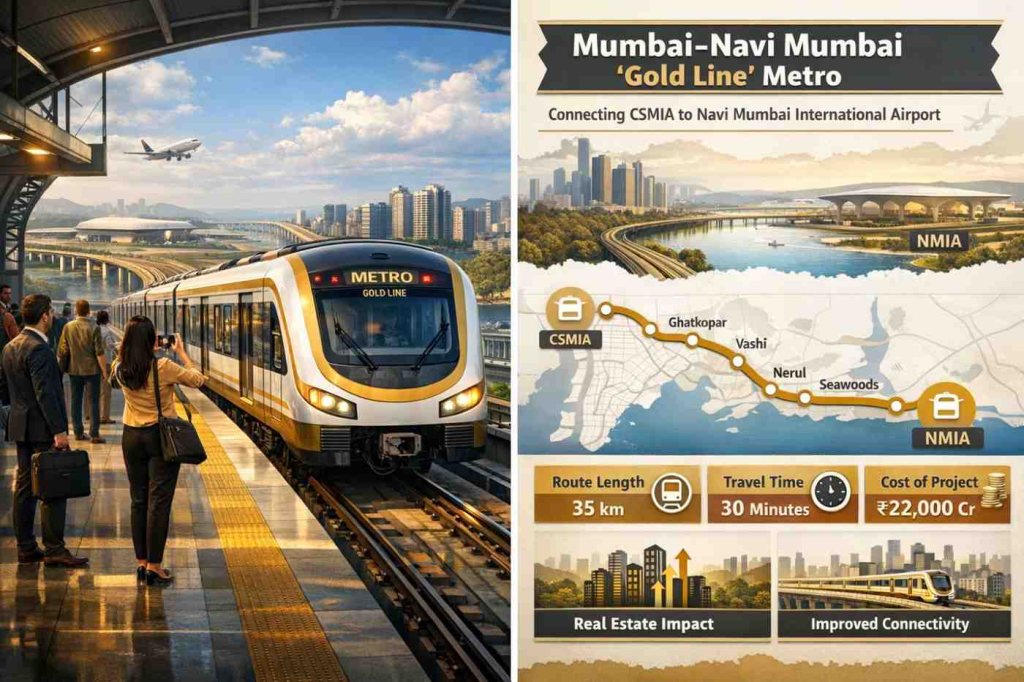
In a major infrastructural move poised to reshape the mobility landscape of the Mumbai Metropolitan Region, the Maharashtra government has given the green signal to the much-anticipated Mumbai-Navi Mumbai Metro Line 8, popularly dubbed the “Gold Line”. Conceived as a 35-kilometre, high-speed metro corridor, this project aims to bridge two of India’s most significant aviation hubs—Chhatrapati Shivaji Maharaj International Airport (CSMIA) in Mumbai and the upcoming Navi Mumbai International Airport (NMIA)—in a travel time of barely 30 minutes, a dramatic reduction from the current 70–90 minute journey by road.
At its core, the Gold Line represents a major shift from incremental transport upgrades to strategic, region-wide connectivity. Approved by the State Cabinet’s infrastructure committee in January 2026 under the leadership of Chief Minister Devendra Fadnavis, the project carries an estimated investment of around ₹22,000–₹23,000 crore. Conceived under a public-private partnership model with contributions from central, state, and private stakeholders, this corridor is expected to serve nearly 9 lakh commuters daily once operational.
Tracing the Route: Strategic Stops, Seamless Integration
The alignment of the Gold Line has been planned to thread through key urban and suburban nodes, linking Mumbai’s established metropolitan fabric with Navi Mumbai’s fast-emerging growth centres. Beginning at CSMIA’s Terminal 2 area in Andheri, the route heads underground through densely trafficked corridors, rising to elevated stretches as it moves eastward and southward. It passes through landmarks such as Ghatkopar, Vashi, Nerul, and Seawoods, before terminating at NMIA—thereby knitting together pivotal employment, residential, and transit nodes across the region.
The design envisages approximately 20 stations along the 35 km corridor, which will interface with several existing and planned transit systems, including suburban railways and other metro lines, creating a more integrated transport ecosystem for the entire metropolitan region.
A distinctive feature of this corridor will be its mixed profile: a 9-kilometre underground segment through the most congested parts of Mumbai, followed by elevated sections as it spans outwards into Navi Mumbai. This combination is intended to ease land acquisition issues, reduce environmental disruption, and facilitate higher operating speeds.
Reimagining Travel Time and Commuter Experience
Historically, journeys between central Mumbai and Navi Mumbai’s developing nodes have been constrained by congested roads and heavily burdened suburban rail lines. Commuters traversing from the city’s western and central suburbs to the new airport site in Navi Mumbai have had to contend with lengthy travel times of over an hour, even in off-peak periods. With the Gold Line in place, this travel will be compressed into an efficient 30-minute metro ride, enabling rapid cross-city mobility that aligns more closely with global airport express services.
Beyond mere speed, the corridor is expected to elevate the commuter experience by offering modern, air-conditioned metro services with frequent intervals, reduced dependence on intermediate feeder systems, and enhanced connectivity to last-mile transport options. Given its role as a dedicated transit spine between two international airports, the Gold Line is also being pitched as India’s first true airport-to-airport rapid transit link, setting a benchmark for future urban rail initiatives.
Real Estate Ripples: From Transit Nodes to Growth Hubs
While the Gold Line’s primary purpose is to improve travel efficiency, its implications for real estate dynamics across Mumbai and Navi Mumbai are generating substantial interest among developers, investors, and urban planners. Experience from other metro corridors in the metropolitan region shows that infrastructure improvements of this scale tend to unlock property value appreciation and stimulate concentrated development around station precincts.
In Navi Mumbai, where metro connectivity has already begun to influence market behaviour, areas such as Kharghar, Taloja, Belapur, Ghansoli, Seawoods, Ulwe and surrounding nodes have seen elevated interest from both homebuyers and investors. The promise of seamless access to two international airports, along with better integration into Mumbai’s wider transport grid, is encouraging developers to reposition these suburbs as credible alternatives to traditional central Mumbai markets.
Property analysts note that transit-oriented development (TOD) often leads to a premium on real estate values, as connectivity becomes a key purchasing criterion for residential and commercial assets alike. Early indicators suggest that regions closer to major junctions on the planned Gold Line corridor could see steady appreciation, driven by expectations of increased footfall, improved amenities, and stronger links to employment hubs across the metropolitan region.
The real estate impact is not limited to Navi Mumbai. Western and central suburbs of Mumbai along the metro catchment may witness secondary benefits, as the Gold Line enhances cross-regional accessibility and disperses commuter traffic more evenly across the urban framework. This can contribute to balanced growth, reduced pressure on central locations, and incremental demand in well-connected secondary markets.
Broader Economic and Urban Transformation
Economists and urban mobility experts view the Gold Line as more than just a transit corridor; it is a catalyst for economic development and spatial restructuring of one of India’s most populous metropolitan regions. By drastically shrinking travel time between key zones—airports, business districts, residential nodes—the corridor is expected to spur job creation, commercial investments, and multiplier effects in sectors such as hospitality, retail, and services.
The integration of the Gold Line with other infrastructure initiatives—such as the Mumbai Trans Harbour Link, enhanced expressways, and expanded suburban rail networks—signals a coordinated effort to transform the Mumbai-Navi Mumbai axis into a high-performance urban corridor. Stakeholders anticipate that such interconnected mobility frameworks will not only enhance quality of life for commuters but also strengthen the region’s competitiveness on the national and global stage.
In conclusion, the Mumbai-Navi Mumbai Gold Line Metro is more than an engineering endeavour; it is a visionary project that promises to redefine how people, businesses, and communities interact across a dynamic metropolitan landscape. Its completion—envisioned by the end of the decade—will mark a milestone in India’s urban transit journey, with lasting implications for connectivity, economic vitality, and real estate growth throughout the region.
Also read : https://digitalherald.in/how-indias-next-gen-gst-reforms-will-lower-your-monthly-grocery-and-medicine-bills/
Add indiapioneer.in as a preferred source google – click here