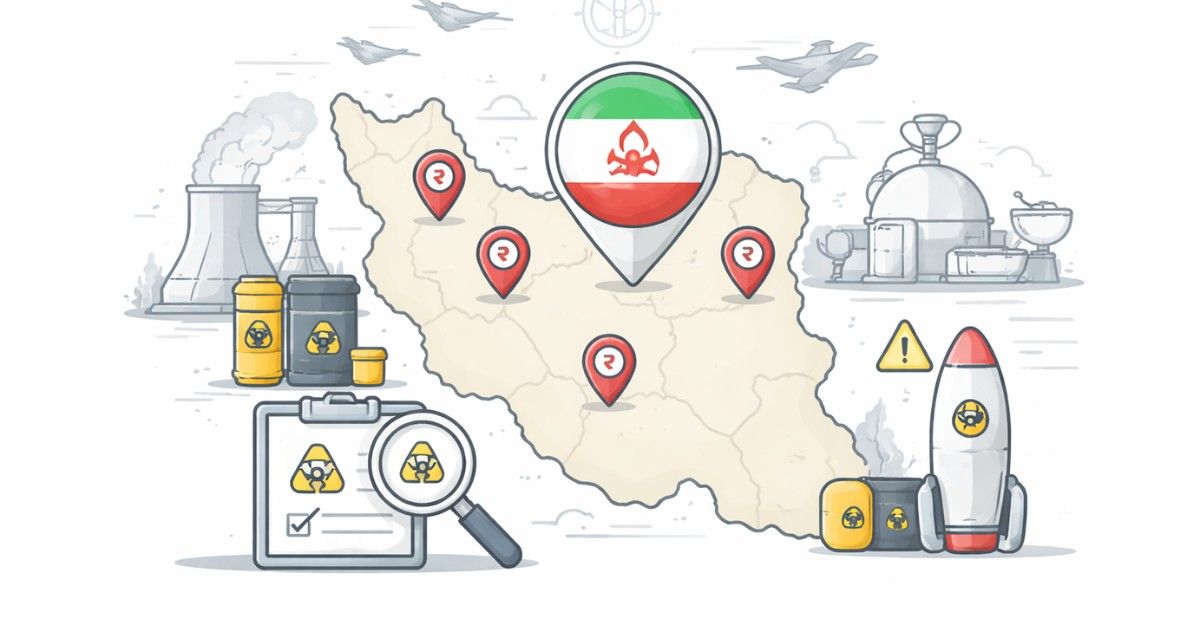
Amid rising geopolitical tensions in West Asia, Iran nuclear sites have come under renewed international scrutiny. Several facilities across the country form the backbone of Iran’s nuclear program and are closely monitored by global nuclear watchdogs and intelligence agencies.
Iran has repeatedly stated that its nuclear activities are intended for peaceful purposes such as electricity generation and scientific research. However, the scale and structure of some Iran nuclear sites have led to continued attention from the international community.
Natanz Nuclear Facility
The Natanz Nuclear Facility is considered one of the most important Iran nuclear sites. Located in Isfahan province about 220 kilometers southeast of Tehran, the complex houses Iran’s primary uranium enrichment operations.
The facility includes both underground and above-ground sections containing centrifuges used to enrich uranium. Much of the infrastructure is built deep underground to protect it from potential attacks.
Recent satellite imagery and international assessments have also highlighted activity and damage around parts of the Natanz complex during regional hostilities, although nuclear watchdogs reported no radiological release.
Fordow Uranium Enrichment Plant
Another major location among Iran nuclear sites is the Fordow Uranium Enrichment Plant, situated near the city of Qom.
Fordow is built deep inside a mountain, making it one of the most fortified nuclear facilities in Iran. Analysts say the site houses advanced centrifuges capable of enriching uranium to higher purity levels.
The facility was publicly revealed in 2009 after Western governments disclosed its construction, bringing it into the center of global nuclear discussions.
Isfahan Nuclear Technology Center
The Isfahan Nuclear Technology Center is another key component of the network of Iran nuclear sites. Located in central Iran, the complex supports multiple stages of the nuclear fuel cycle.
The site includes a uranium conversion facility that transforms uranium into uranium hexafluoride gas, which is then used in enrichment centrifuges. It also hosts laboratories, research reactors and fuel fabrication plants.
International inspectors have previously noted that enriched uranium has been stored at the Isfahan complex.
Arak Heavy Water Reactor
The Arak Heavy Water Reactor, also known as the Khondab reactor, is another frequently mentioned facility when discussing Iran nuclear sites.
Heavy water reactors can produce plutonium as a by-product, which is why the facility has been closely monitored. Under the 2015 nuclear agreement, the reactor’s design was modified to reduce proliferation risks.
Bushehr Nuclear Power Plant
The Bushehr Nuclear Power Plant, located along the Persian Gulf coast, is Iran’s only operational nuclear power station used for electricity generation.
Unlike other Iran nuclear sites, Bushehr operates using fuel supplied by Russia, which is returned after use, reducing concerns over weapons-related material.
Continued International Monitoring
The network of Iran nuclear sites continues to be monitored by the International Atomic Energy Agency and other global institutions. These facilities play a central role in discussions surrounding Iran’s nuclear program and ongoing diplomatic efforts.
As regional tensions evolve, analysts say the status and security of Iran nuclear sites will remain a key focus for governments and international organizations assessing developments in the Middle East.