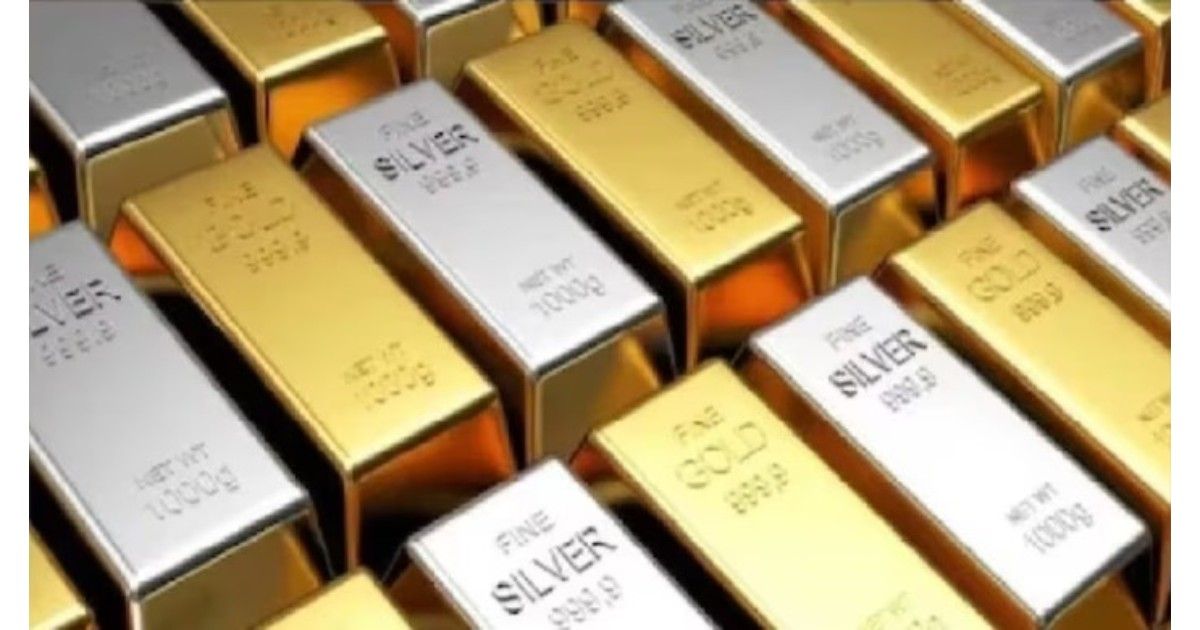
New Delhi, March 27: Gold prices declined across major Indian cities on Friday, reversing a brief upward trend seen in the previous session. Silver prices also witnessed a slight drop, reflecting cautious sentiment in the bullion market amid ongoing global uncertainties.
In early trade, 24-karat gold prices fell by approximately ₹1,970 to ₹2,140 per 10 grams across key jewellery markets, while silver slipped by around ₹200 per kilogram.
Gold Prices Across Major Cities
The decline has brought gold rates within a relatively narrow band across the country. Most major sarafa markets are currently quoting:
- 24-karat gold: ₹1,44,540 to ₹1,44,690 per 10 grams
- 22-karat gold: ₹1,32,490 to ₹1,32,640 per 10 grams
In New Delhi, 24-karat gold is priced at ₹1,44,690 per 10 grams, while 22-karat gold stands at ₹1,32,640.
In Mumbai, prices are slightly lower, with 24-karat gold at ₹1,44,540 and 22-karat at ₹1,32,490 per 10 grams.
Other major cities are witnessing similar trends:
- Ahmedabad: ₹1,44,590 (24K), ₹1,32,540 (22K)
- Chennai, Kolkata, Bhopal, Lucknow, Patna, Jaipur: Prices largely within the same national range
- Bengaluru, Hyderabad, Bhubaneswar: ₹1,44,540 (24K), ₹1,32,490 (22K)
The uniformity in pricing reflects stable but subdued demand conditions across regional markets.
Silver Prices Show Minor Weakness
Silver prices also edged lower, though the decline was less pronounced compared to gold.
In the Delhi bullion market, silver is trading at around ₹2,49,900 per kilogram, down by approximately ₹200 from the previous session.
The limited movement in silver prices suggests relatively stable industrial and investment demand, despite broader market caution.
Key Drivers Behind the Price Movement
The recent dip in gold and silver prices can be attributed to a mix of domestic and global factors:
1. Global Geopolitical Uncertainty
Ongoing tensions in West Asia, particularly linked to the Israel–Iran situation, have kept global markets volatile. While such tensions often support gold as a safe-haven asset, short-term price movements can fluctuate based on investor positioning.
2. Crude Oil Price Volatility
Fluctuations in crude oil prices have contributed to uncertainty in global financial markets. Higher oil prices can influence inflation expectations, which in turn affect precious metal prices.
3. Profit Booking After Recent Gains
Market participants may be booking profits after recent gains in bullion prices, leading to short-term corrections.
4. Currency Movements
Changes in the value of the Indian rupee against the US dollar also play a role in determining domestic gold prices, as India relies heavily on imports for its gold supply.
Understanding Gold Pricing in India
Gold prices in India are influenced by several components beyond global rates. These include:
- Import duties and taxes
- Currency exchange rates
- Local demand and supply
- Seasonal factors such as weddings and festivals
The difference between 24-karat and 22-karat gold is also important for consumers. While 24-karat gold is considered pure, 22-karat gold is commonly used in jewellery due to its durability.
Market Sentiment and Buyer Behaviour
The slight easing in gold prices may provide some relief to buyers, particularly those planning purchases for weddings or investment purposes.
However, market sentiment remains cautious. Jewellers and physical buyers are closely monitoring global developments before making large purchases.
Industry observers note that while demand has not weakened significantly, buyers are adopting a wait-and-watch approach due to price volatility.
Impact on Consumers and Investors
For consumers, the current dip offers a potential opportunity to purchase gold at slightly lower rates compared to earlier highs.
For investors, the situation highlights the importance of tracking global cues. Gold is often seen as a hedge against inflation and uncertainty, but short-term price movements can vary.
Silver, on the other hand, has both industrial and investment demand, which can influence its price differently from gold.
Broader Economic Context
The bullion market’s movement reflects broader economic conditions, including global trade dynamics, geopolitical developments, and monetary policies.
Uncertainty in international markets often leads to fluctuations in commodity prices, including precious metals. As a result, domestic bullion rates remain sensitive to global trends.
Outlook for Bullion Markets
Analysts suggest that gold and silver prices may continue to experience volatility in the near term, depending on:
- Developments in global geopolitical tensions
- Movements in crude oil prices
- Central bank policies and interest rates
- Currency fluctuations
If uncertainty persists, gold could regain strength as a safe-haven asset. However, short-term corrections like the current dip are not uncommon.
Market Outlook
The decline in gold and silver prices across Indian markets signals a temporary softening after recent gains. While the drop is modest, it reflects cautious sentiment driven by global and domestic factors.
For now, the bullion market remains in a phase of adjustment, with both buyers and investors closely tracking developments before making decisions.
Inputs & Images: Hindusthan Samachar
Edited By: Akshaya Polepalli
Also Read:Narendra Modi Congratulates Balendra Shah, Signals Continued Focus on India–Nepal Ties