The Graduate Aptitude Test in Engineering (GATE) 2026 is being conducted by the Indian Institute of Technology (IIT) Guwahati on behalf of the National Coordination Board. The organising institute released the admit cards in January 2026 and the computer-based examinations are scheduled across two weekends in February. Candidates preparing to sit the test must follow a specific set of instructions on documentation, reporting time and in-hall conduct; the official brochure and the examination portal set out mandatory requirements for entry and for the conduct of the test.
Background
GATE is a national-level exam used primarily for admission to postgraduate engineering and technology programmes and, in some cases, for recruitment to public sector undertakings. The score is valid for a fixed period and is widely used by higher-education institutions and employers as a standardised measure of technical knowledge at undergraduate level. For 2026, IIT Guwahati served as the organising institute; the public online presence—both the official GATE 2026 website and the GOAPS (GATE Online Application Processing System) candidate portal—have been the primary vehicles for notifications, admit-card distribution and candidate services. The official schedule released by the organising institute sets out key dates for admit-card availability, examination dates and the result announcement.
The GATE 2026 information brochure, issued by the organising institute, remains the authoritative document on procedural and logistical matters. It includes specifications for identity documents, photograph and signature requirements, exam-day conduct, accommodations for persons with disabilities and the exact process for admit-card retrieval via the GOAPS portal. The brochure and the website together form the official instruction set that centres and invigilators will follow.
Recent developments — admit-card release and schedule
The organising institute announced that the GATE 2026 admit cards were made available for download from the GOAPS candidate portal in January 2026. The official site lists the admit-card availability date as 13 January 2026 and confirms that admit cards will not be sent by post or email; candidates must download and print their own copy. The same official calendar entry shows the GATE 2026 examination dates as 7, 8, 14 and 15 February 2026, with the results scheduled for announcement in March 2026.
The information brochure reiterates that admit cards can only be downloaded from the application portal during the published window and emphasises the need for a printed A4-size copy. It warns that admit cards that do not show a clear photograph and signature may be considered invalid and that no admit card will be issued or dispatched by post. Candidates who detect discrepancies on their downloaded admit card are advised to consult the zonal GATE office contact details provided in the brochure and on the website.
Press and education portals that monitor major national examinations published guidance notes after the admit-card release, confirming the dates and advising candidates on download procedures and the need to verify exam centre addresses and session timings. These outlets have echoed the official warning that late entry is not permitted once the test session is underway and that the admit card plus original identity proof are mandatory for entry.
How to retrieve your admit card (official route)
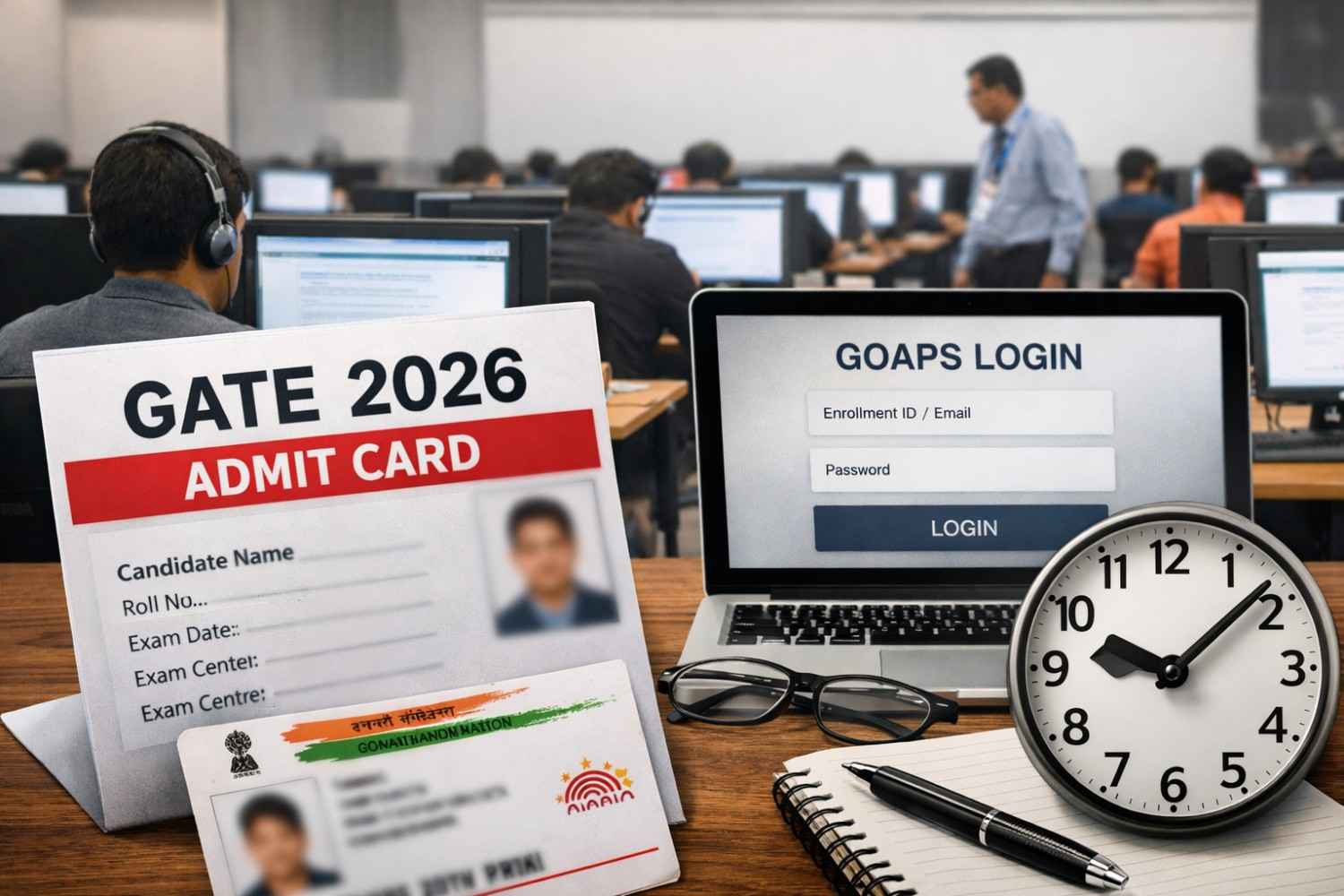
Admit-card retrieval is handled only through the GOAPS candidate login. Candidates must log in using the Enrollment ID or their registered email and the password created during registration. After logging in, a candidate must navigate to the admit-card or “Download Admit Card” link on the portal. The file appears as a PDF and should be checked carefully for personal details, photograph, signature, exam date, shift, reporting time and the address of the allocated exam centre.
The official materials advise that candidates print the admit card on A4 paper using a laser printer and preferably in colour. Multiple clear printouts are recommended so that the candidate has a spare if one copy becomes damaged. The brochure makes clear that the admit card is valid only when the photograph and signature are legible. If the photograph or signature on the admit card is unclear — either because the original upload was poor or because of a technical issue — candidates must seek rectification via the Application Portal’s published procedures and the zonal office contacts.
Identification and documentation required on exam day
The brochure sets out the list of acceptable identity documents and the requirement that the candidate bring the same original ID that was specified in the application form. Acceptable forms include Aadhaar-UID (including the virtual Aadhaar ID where applicable), government-issued photo ID, passport, PAN card, voter identity card and driving licence. The photo ID must clearly display the candidate’s name, photograph, identity document number and date of birth. For foreign candidates appearing at centres in India, a valid passport or government-issued identity document is mandatory.
In addition to the printed admit card, the brochure and the website instruct candidates to present the original photo ID at the entry checkpoint and to keep a spare passport-size photograph (the same photograph as uploaded with the application) available if requested at the centre. Candidates who have applied under reserved categories or who require disability accommodations must carry the documentary proof that they uploaded during the application, as those may be required for verification at the centre. The instructions emphasise that discrepancies between the name on the ID and the application form can cause refusal of entry or later complications with scorecards and admissions.
Reporting time, seating and late-entry rules
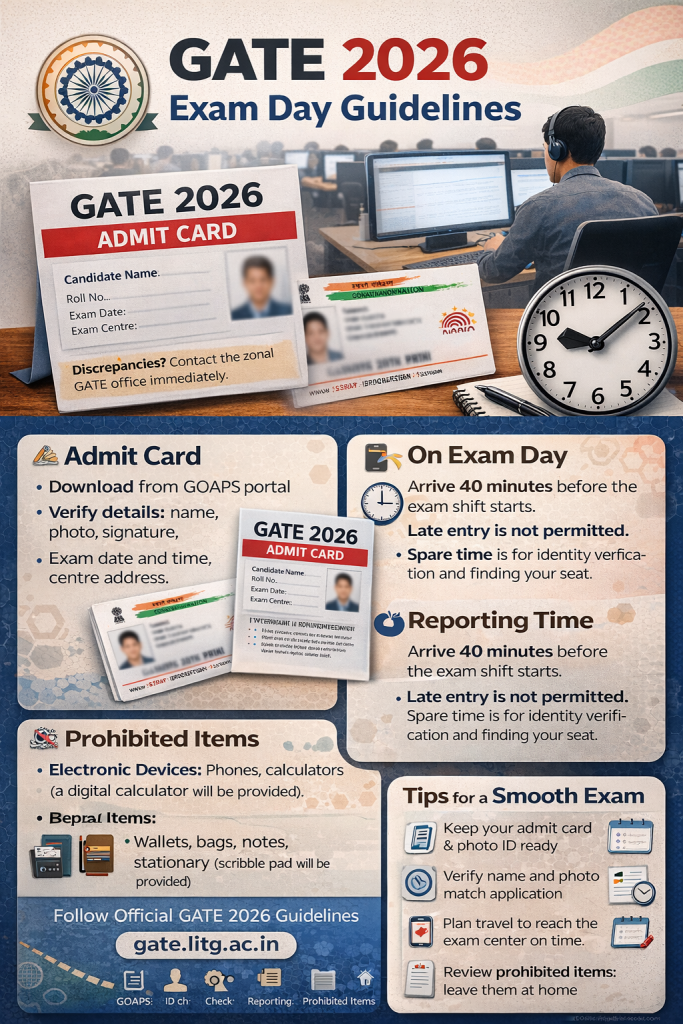
The official brochure explains the timing and seating protocol for the computer-based test. Candidates will be permitted to occupy their allotted seats 40 minutes before the scheduled start of the examination. The exam duration is three hours for standard candidates and four hours for candidates who have been approved to receive compensatory time (for example, candidates using a scribe). The examination software will enforce the end of the session at the pre-set time. The brochure states explicitly that candidates must not enter the examination hall after the test has started; late entry provisions are generally stringent and admission depends on the centre’s specific instructions and the timing of arrival relative to reporting time.
Several independent education portals and test-prep platforms, while restating the official rules, have highlighted the practical consequence for candidates: travel planning should take into account traffic and the time required for identity checks, security screening and seat allocation, particularly for candidates who travel to a centre outside their city of residence. Candidates assigned to a centre in a different city should therefore verify their travel and local accommodation arrangements well in advance.
In-hall conduct, allowed and prohibited items
The GATE 2026 brochure contains a clear code of conduct for the examination hall. The following points are set out as mandatory requirements or prohibitions and are enforced by invigilators at centres:
The test is delivered in computer-based format and a virtual scientific calculator is provided on the computer screen for calculations during the exam. Any physical calculators are forbidden inside the hall. Mobile phones, earphones, smart watches (analogue, digital or smart), Bluetooth devices, wallets, books, papers, hand-written notes, pens, pencils, pen/pencil pouches and other electronic or communication devices are strictly prohibited. Candidates found in possession of such devices can be disqualified even if the devices are switched off. The brochure also states that personal belongings are not the responsibility of the organising institute or the exam centre.
For rough work, the centre will provide a scribble pad (or equivalent). Candidates must write their name and registration number on the scribble pad before using it, may possess only one scribble pad at a time, and must return it to the invigilator before leaving the examination hall. The brochure sets out that the invigilator will manage the distribution and collection of this material. Any deviation from these procedures can be treated under the disciplinary rules specified in the brochure.
Accessibility provisions and compensatory time
The brochure includes specific provisions for candidates with disabilities. Persons with disabilities (PwD), including those with dyslexia or similar learning disabilities, may request compensatory time and, where appropriate, the assistance of a scribe. The allotment of compensatory time for candidates with an approved request is automatic and will be reflected on their computer console; on-spot requests at the examination hall are not entertained. The brochure also encourages PwD candidates to visit the examination centre a day before the test to familiarise themselves with the arrangements. The concessions, documentation requirements and the rules governing scribes are set out in the brochure and are aligned with the government’s policy on accommodations.
What to check on your admit card and what to do if there are discrepancies
When a candidate downloads the admit card, the brochure and the website advise immediate verification of all printed details. Candidates should check their name, photograph, signature, date of birth, paper(s) registered, exam date and shift, reporting time and the address of the exam centre. If any detail is incorrect or the photograph/signature is unclear, the candidate should contact the zonal office using the contact information provided on the GATE website and follow the rectification procedure laid out in the portal and the information brochure.
Because admit cards are not posted and will not be emailed, the availability window on the portal is the only official source. Candidates are therefore advised to download the admit card well in advance of their scheduled test date and to retain extra printed copies. The brochure also cautions that the candidate’s name in the application should match the name on the ID document exactly, without prefixes or titles, because the scorecard will be issued as per the name entered in the application form.
Disciplinary rules and consequences of violations
The IGATE brochure contains a disciplinary clause covering instances of malpractice or breach of the code of conduct. Candidates found using unauthorised devices, copying, communicating, or attempting to manipulate the computer system face disqualification and may be subjected to further actions as per the rules set by the national coordinating body. The brochure emphasises that any candidate found to have given incorrect information during registration or to have submitted fraudulent documents may be debarred and subject to legal action. Centres will follow the invigilation and reporting protocols described; any incident will be recorded and handled by the zonal coordinating institute in consultation with the organising institute.
Practical impact on candidates and institutions
For candidates, the immediate practical impacts of the admit-card release and the exam-day rules are logistical and administrative. A downloaded admit card confirms the assigned centre and session; candidates must plan travel and lodging (if required) according to the schedule and centres listed on the portal. Because late entry is strictly regulated and personal belongings are not safeguarded by the centre, candidates need to make contingency plans for travel delays and for secure storage of personal items.
For institutions and employers that use GATE scores—graduate departments, scholarship programmes and some public sector recruiters—the GATE schedule fixes timelines for admissions and recruitment cycles in the months immediately following the exam. Institutions that rely on GATE to shortlist candidates will follow their own processes for counselling and admission; the GATE score itself is just one element in that chain, and admission or recruitment decisions remain at the discretion of the admitting or hiring body. The official GATE information clarifies that qualifying the test does not automatically guarantee admission, scholarship or employment.
Frequently observed issues and recommended checks before exam day
Experience from previous years and the clarity of the 2026 brochure suggest several areas where candidates commonly face issues: mismatched names on ID, unclearly scanned photographs or signatures, failure to carry the exact ID listed in the application form, and last-minute travel delays to the exam city. Candidates are advised to check the name format used in the application (avoid prefixes such as Mr./Dr./Shri/Smt.), ensure that the ID uploaded during registration is the one they will bring, keep additional copies of the admit card and the passport-size photograph, and to verify that any concession or category documentation is accessible in original form for inspection.
The brochure also advises candidates to check the FAQs and the zonal office contact list for clarifications and to use the GOAPS portal for submission of any official rectification requests. Because the admit card is the only official proof for seat allotment and entry, candidates should not rely on secondary or social-media sources for the admit-card PDF; the GOAPS portal is the single authoritative source.
Enforcement and transparency: what the official documents show
The combination of the official website notice and the information brochure presents a two-fold approach: formal notification of dates, admit-card availability and schedules via the website, and detailed operational rules, documentation lists and disciplinary clauses in the brochure. This structure is intended to provide procedural transparency for both candidates and centres: the website announces what candidates need to know and where to retrieve the admit card; the brochure explains the procedures centres will follow, the technical format of the examination, and the exact standards for identity verification and conduct.
The presence of zonal office contact information and an FAQ page is a further step to support candidates who encounter problems during admit-card download or who need clarification. Candidates who are unable to resolve an issue through FAQs are instructed to reach out to the zonal coordinating institute, as listed in the brochure and on the official site.
What candidates should do now
Candidates who have registered for GATE 2026 should take the following actions based on the official materials. First, log in to the GOAPS portal, download and print the admit card on A4 paper and verify the photograph, signature and personal details. Second, check the exam date, session and the reporting time and plan travel to reach the centre well in time to be seated 40 minutes before the scheduled start. Third, assemble the original photo ID specified at the time of registration and any category or disability documentation if applicable. Fourth, familiarise yourself with the list of prohibited items—the virtual calculator will be provided during the test and no electronic devices are allowed inside the hall. Fifth, if there is any discrepancy on the admit card, use the GOAPS portal or the zonal office contacts to request rectification immediately. Finally, plan for contingencies such as travel delays and keep spare copies of the admit card and a recent passport-size photograph handy. These steps are in line with the directions issued by the organising institute and set out in the information brochure.
Conclusion
The GATE 2026 organising institute has published a clear timetable and a detailed operations manual that cover admit-card retrieval, identity verification, exam-day conduct, accessibility accommodations and disciplinary procedures. The admit card is available only via the GOAPS portal and the brochure contains mandatory instructions for printed A4 admit cards, original photo ID presentation and in-hall behaviour, including the provision of a virtual scientific calculator and the prohibition of personal electronic devices. Candidates must follow the published instructions precisely; failure to present the correct documents or to comply with in-hall rules can result in denial of entry or disqualification. For authoritative updates, candidates should consult the official GATE 2026 website and the GOAPS portal.
Add indiapioneer.in as preferred source on google – click here