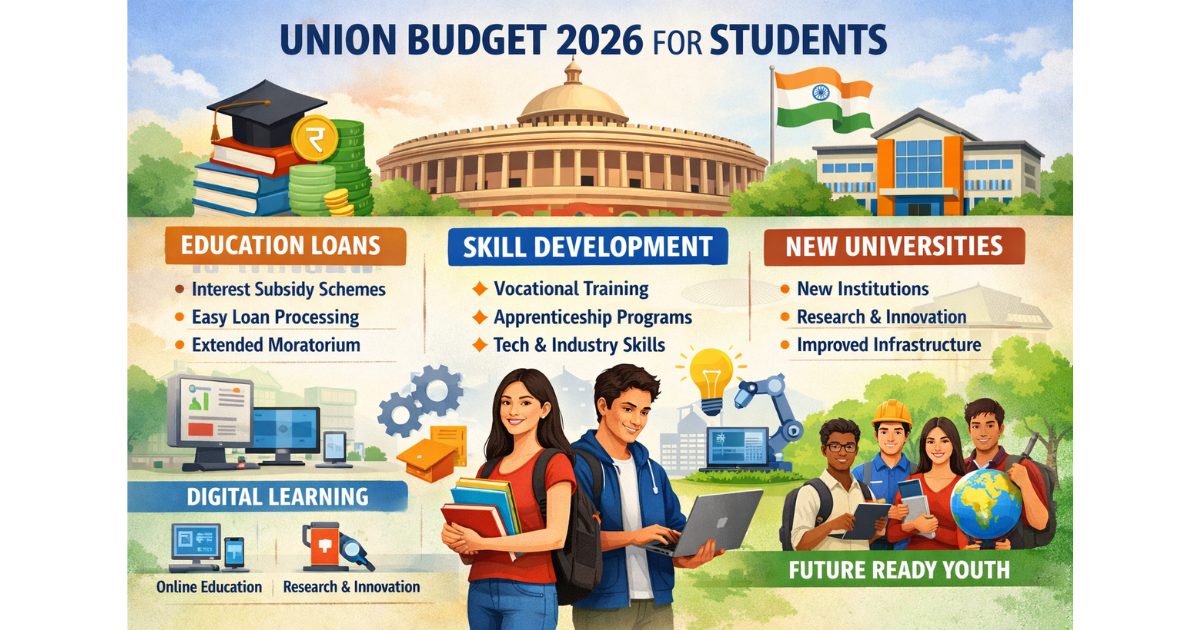
The Union Budget 2026–27 has placed students and young learners at the heart of India’s long-term growth strategy. At a time when rising education costs, employability gaps, and global competition are shaping student aspirations, the government has announced a series of targeted measures aimed at improving access to education, reducing financial stress, and strengthening skill readiness. From reforms in education loans to large-scale investments in skill development and the establishment of new universities, the budget signals a decisive push towards building a future-ready student population.
Education Loans: Making Higher Studies More Accessible
One of the most significant announcements for students in the Union Budget 2026 relates to education financing. Acknowledging the financial burden faced by middle- and lower-income families, the government has proposed several reforms to make education loans more student-friendly.
Key Highlights on Education Loans
- Expansion of interest subsidy schemes for students from economically weaker sections, covering both domestic and overseas education.
- Simplification of loan approval processes through digital verification, reducing delays and paperwork.
- Extension of moratorium periods, allowing students more time after course completion before repayment begins.
- Special focus on professional courses such as engineering, medicine, law, and management, as well as emerging fields like artificial intelligence, data science, and biotechnology.
These measures aim to ensure that financial constraints do not prevent meritorious students from pursuing higher education, especially in high-demand and future-oriented disciplines.
Boost to Skill Development and Employability
Recognising that degrees alone are no longer sufficient in today’s job market, the Union Budget 2026 places strong emphasis on skill development and vocational training. The government has aligned education policy closely with industry needs to address the employability gap among graduates.
Major Skill Development Initiatives
- Increased allocation for national skill missions, focusing on practical, job-oriented training.
- Introduction of industry-linked certification programs in partnership with private companies and global institutions.
- Expansion of apprenticeship programs, offering paid, hands-on experience to students during and after their studies.
- Special skill development hubs in Tier-2 and Tier-3 cities to reduce regional disparities.
The budget also highlights reskilling and upskilling opportunities for college students, ensuring they remain adaptable in a rapidly changing employment landscape.
New Universities and Expansion of Higher Education Infrastructure
To meet the growing demand for quality higher education, the Union Budget 2026 announces the establishment of new universities and the expansion of existing institutions across the country.
Focus Areas in Higher Education Expansion
- Setting up of new central and state-supported universities, particularly in underserved and aspirational districts.
- Strengthening of research-oriented institutions to promote innovation and academic excellence.
- Increased funding for infrastructure upgrades, including smart classrooms, laboratories, and digital libraries.
- Encouragement for multidisciplinary education, allowing students to combine science, arts, commerce, and technology streams.
These initiatives aim to improve student-to-teacher ratios, reduce overcrowding in existing institutions, and enhance the overall quality of higher education.
Digital Education and Learning Technology Support
The Union Budget 2026 continues to build on the digital education momentum created in recent years. With technology becoming an integral part of learning, the budget allocates resources to improve digital access for students across socio-economic backgrounds.
Digital Learning Measures
- Expansion of national digital learning platforms offering free and low-cost online courses.
- Financial support for institutions to adopt advanced educational technology tools.
- Promotion of hybrid learning models that combine classroom teaching with online resources.
- Focus on digital literacy programs for students and educators alike.
These steps are expected to make quality education more inclusive, especially for students in remote and rural areas.
Support for Research, Innovation, and Student Startups
The budget also encourages students to move beyond traditional career paths by supporting research and entrepreneurship. By fostering innovation at the academic level, the government aims to create job creators rather than job seekers.
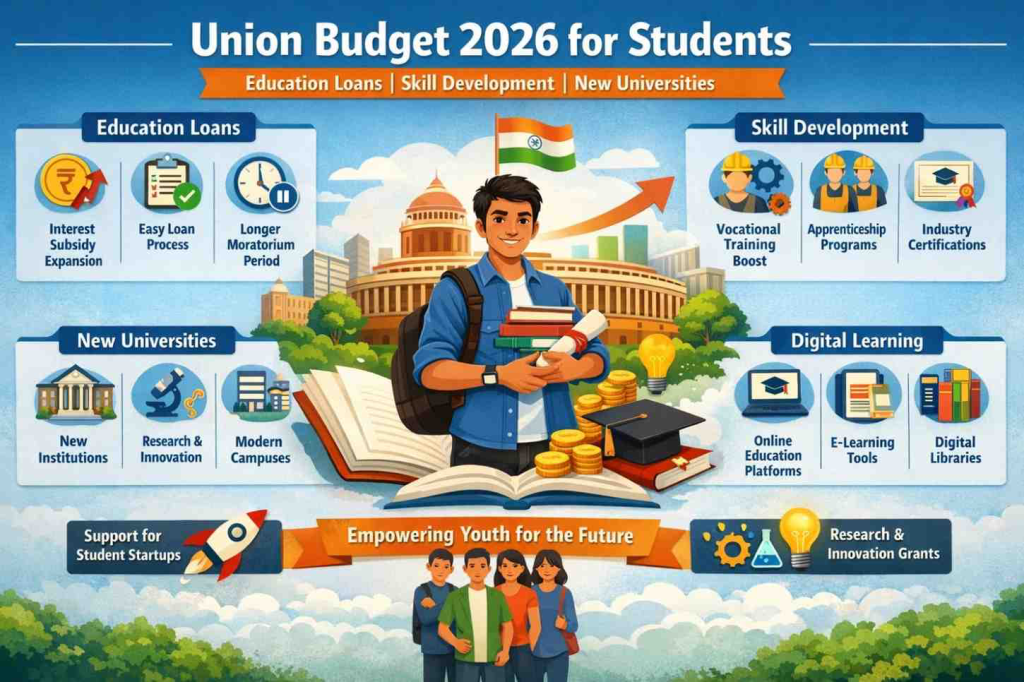
Research and Startup Support
- Increased funding for student-led research projects in science, technology, and social sciences.
- Dedicated grants for innovation cells in universities and colleges.
- Strengthening incubation centres to support student startups with mentorship and financial assistance.
- Encouragement for collaboration between academia, industry, and research institutions.
This focus aligns with India’s ambition to become a global knowledge and innovation hub.
What the Union Budget 2026 Means for Students
Overall, the Union Budget 2026 presents a comprehensive roadmap for students, addressing financial challenges, employability concerns, and access to quality education. By combining education loan reforms, skill development initiatives, and expansion of higher education infrastructure, the budget seeks to empower students to compete in both domestic and global markets.
For students and parents alike, these announcements offer reassurance that education and youth development remain national priorities. The success of these measures, however, will depend on effective implementation and timely execution on the ground.
Add indiapioneer.in as a preferred source on google – click here