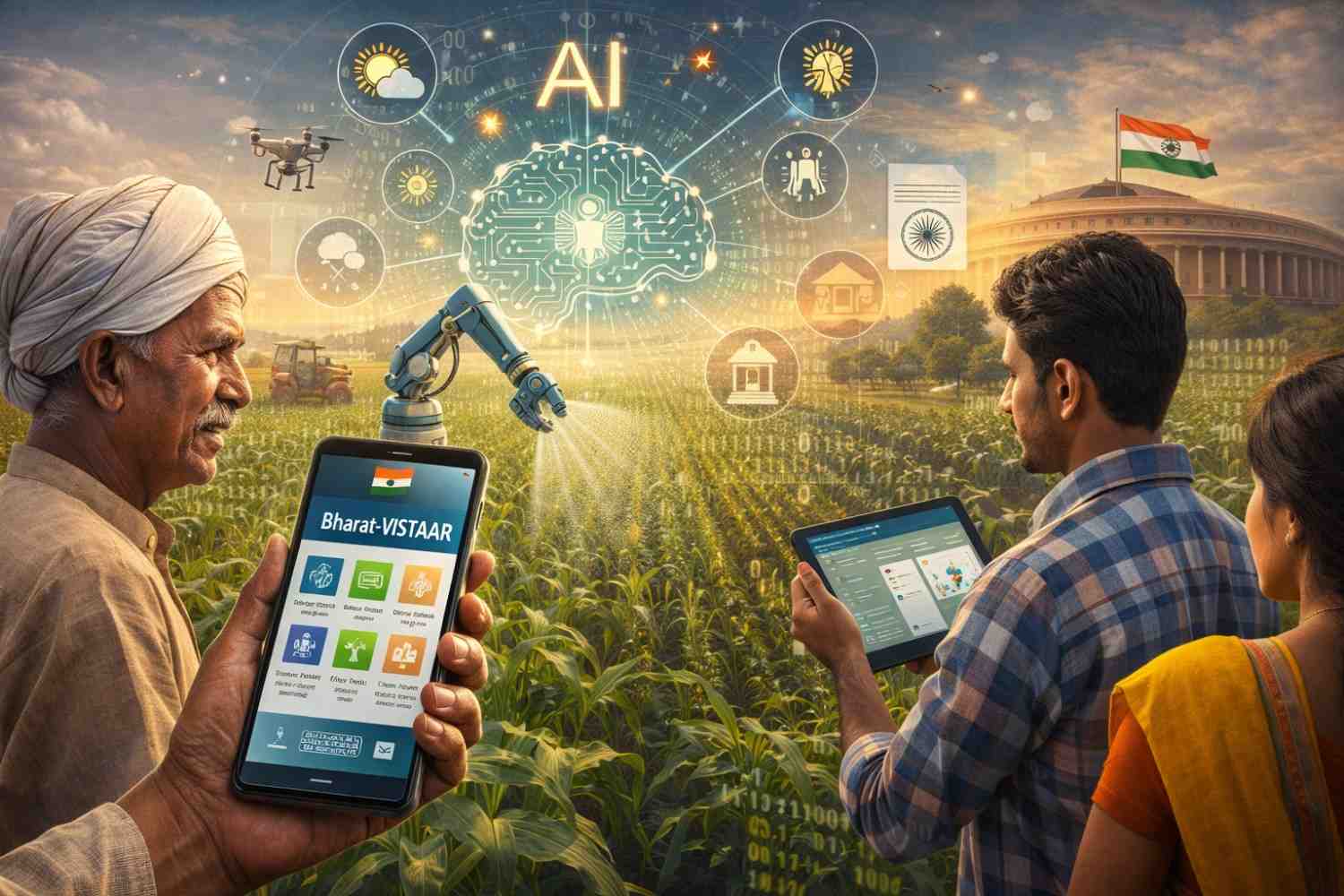
The Union Budget 2026–27 marked a significant development in India’s agricultural policy landscape with the announcement of Bharat-VISTAAR, a new multilingual artificial intelligence platform designed to support farmers through data-driven advisories. Introduced as part of the government’s broader digital agriculture strategy, Bharat-VISTAAR, short for Virtually Integrated System to Access Agricultural Resources, aims to integrate multiple agricultural data systems into a single, accessible interface for farmers across the country.
The initiative is positioned as a technology-enabled mechanism to bridge long-standing gaps between agricultural research, government schemes and farm-level decision-making. By combining artificial intelligence with existing public digital infrastructure, the platform seeks to deliver timely, location-specific guidance to farmers on crop planning, weather risks, pest management and access to official services.
This article examines the background, operational framework, key rules and expected benefits of Bharat-VISTAAR, and assesses what the initiative could mean for Indian farmers, particularly small and marginal cultivators.
Background: digital transformation of Indian agriculture
Agriculture continues to play a central role in India’s economy, employing a substantial share of the population and contributing significantly to rural livelihoods. Despite decades of policy interventions, farmers face persistent challenges, including climate variability, fragmented landholdings, limited access to timely information, and uneven reach of extension services.
In recent years, the government has increasingly turned to digital tools to address these constraints. Initiatives such as digital soil health cards, online agricultural marketplaces and the creation of AgriStack—a foundational digital framework integrating farmer data—reflect a broader effort to modernise agricultural governance and service delivery.
Bharat-VISTAAR emerges from this policy context. It builds on existing digital infrastructure and aims to enhance the reach and effectiveness of agricultural advisories by using artificial intelligence to process large volumes of data and translate them into practical guidance for farmers. The initiative aligns with the government’s stated objective of promoting technology-led, inclusive growth in the farm sector.
What is Bharat-VISTAAR?
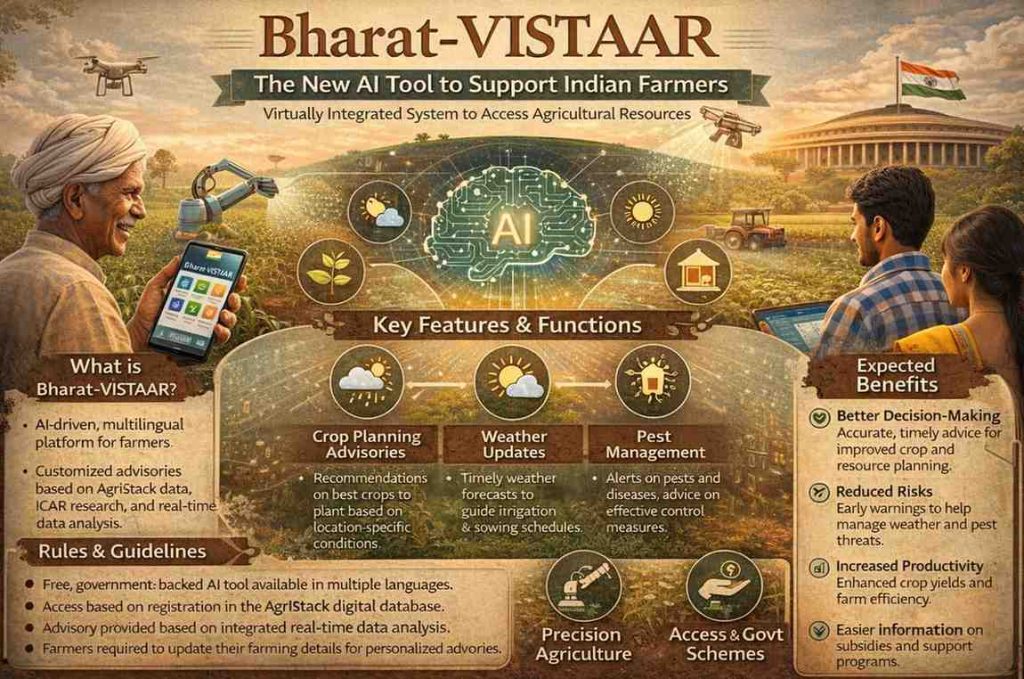
Bharat-VISTAAR is an AI-driven, multilingual digital platform intended to provide farmers with integrated access to agricultural information, scientific advisories and government services. The system is designed to function as a single window through which farmers can receive customised guidance based on their location, crop profile and prevailing environmental conditions.
At its core, the platform integrates farmer and land records maintained under AgriStack with scientific recommendations developed by agricultural research institutions. Artificial intelligence systems analyse this information alongside weather data, soil indicators and crop calendars to generate tailored advisories.
The platform is envisaged as a decision-support tool rather than a replacement for existing extension services. By delivering recommendations directly to farmers in their preferred language, Bharat-VISTAAR seeks to supplement traditional channels and reduce information gaps that often affect productivity and risk management.
Operational structure and key rules
Integrated data architecture
A defining feature of Bharat-VISTAAR is its integrated data architecture. The platform brings together multiple datasets that were previously dispersed across departments and institutions. These include farmer profiles, land and crop records, weather forecasts and agronomic research outputs.
Artificial intelligence algorithms process this combined data to generate farm-specific advisories. The objective is to move away from uniform recommendations and towards guidance that reflects local conditions, crop stages and seasonal risks.
The platform is designed to operate within existing government data frameworks, ensuring alignment with public digital infrastructure and policy objectives.
Multilingual access and inclusivity
Recognising India’s linguistic diversity, Bharat-VISTAAR has been designed as a multilingual platform. Advisory services are expected to be delivered initially in major languages, with phased expansion to additional regional languages.
Language accessibility is critical to the platform’s adoption, as linguistic barriers have historically limited the reach of digital agricultural tools. By providing advisories in local languages, the platform aims to improve comprehension and usability among farmers with varying levels of formal education.
Real-time advisory and decision support
Bharat-VISTAAR’s AI systems are intended to deliver near real-time advisories by continuously analysing dynamic data such as weather forecasts and crop conditions. This capability is particularly relevant in agriculture, where timely decisions can significantly affect outcomes.
The platform is expected to assist farmers in decisions related to sowing, irrigation scheduling, fertiliser application and pest control. By anticipating risks and suggesting appropriate responses, the system seeks to support proactive farm management.
Linkages with government schemes
In addition to agronomic advice, Bharat-VISTAAR is expected to provide information on relevant government schemes and services. By matching farmer profiles with scheme eligibility criteria, the platform could help farmers identify benefits and support programmes applicable to their operations.
This integration is intended to improve awareness and uptake of official schemes, which often suffer from limited outreach at the grassroots level.
Policy context and institutional framework
The introduction of Bharat-VISTAAR reflects the government’s emphasis on emerging technologies as instruments of economic transformation. In the Union Budget 2026–27, artificial intelligence was identified as a key enabler across multiple sectors, including agriculture.
The platform also aligns with broader efforts to strengthen agricultural extension through digital means. Traditional extension systems, while effective in some regions, face capacity constraints. Digital platforms are seen as a way to scale advisory services without proportionate increases in manpower.
Bharat-VISTAAR’s institutional framework is expected to involve coordination between multiple government agencies, research institutions and technology partners. Effective governance and inter-departmental cooperation will be central to its functioning.
Expected benefits for farmers
Improved access to information
One of the primary benefits of Bharat-VISTAAR is improved access to reliable, scientific information. Farmers often rely on informal sources or generic advisories that may not suit local conditions. A centralised, AI-enabled platform could help bridge this gap by delivering accurate and relevant guidance.
Access to timely information can influence critical decisions such as crop choice, planting time and input use, with direct implications for productivity and income.
Enhanced risk management
Agriculture is inherently risky, with weather variability, pests and diseases posing constant threats. By analysing weather patterns and historical data, Bharat-VISTAAR aims to provide early warnings and preventive advice.
This could help farmers prepare for adverse conditions, reduce crop losses and manage uncertainty more effectively. Improved risk management is particularly important for small and marginal farmers with limited capacity to absorb shocks.
Resource efficiency and sustainability
Targeted advisories on fertiliser and pesticide use could promote more efficient resource utilisation. By aligning input recommendations with actual crop and soil needs, the platform may help reduce excessive input use, lowering costs and environmental impact.
Such efficiency gains are consistent with broader sustainability objectives and efforts to promote climate-resilient agriculture.
Better access to public services
By integrating information on government schemes, Bharat-VISTAAR could simplify farmers’ interaction with public programmes. Improved awareness and targeted guidance may lead to higher participation in schemes related to credit, insurance, input subsidies and income support.
This could strengthen the overall effectiveness of agricultural policy interventions.
Challenges and constraints
Digital divide and infrastructure gaps
Despite expanding digital connectivity, significant gaps remain in rural internet access and smartphone penetration. Farmers in remote or underserved areas may face difficulties accessing digital platforms, limiting the reach of Bharat-VISTAAR.
Addressing these gaps will require complementary investments in infrastructure, digital literacy and on-ground support mechanisms.
Adoption and trust
Farmers’ willingness to rely on AI-generated advisories will depend on the accuracy, relevance and consistency of the information provided. Building trust in digital recommendations will take time and may require demonstration projects and integration with existing extension networks.
Data governance and privacy
The use of integrated data systems raises important questions about data accuracy, privacy and consent. Ensuring robust safeguards for farmer data and transparent governance of AI systems will be essential to maintaining confidence in the platform.
Conclusion
Bharat-VISTAAR represents a significant step in India’s evolving approach to digital agriculture. By combining artificial intelligence with integrated data systems and multilingual access, the platform aims to enhance the reach and quality of agricultural advisories available to farmers.
Its potential benefits include improved decision-making, better risk management, enhanced productivity and more effective access to government services. However, the real impact of Bharat-VISTAAR will depend on effective implementation, sustained institutional coordination and efforts to address digital access and trust-related challenges.
As the platform is rolled out, its performance will be closely watched as an indicator of how emerging technologies can be applied to support India’s diverse and complex agricultural sector.
Also read : Union Budget 2026 for Students: Key Policies for Education Loans, Skill Development, and New Universities
Add indiapioneer.in as a preferred source on google – click here